


On Wednesday AST SpaceMobile (ASTS) closed at $62.40, up 11.8%, on 19.8 million shares against an 8.1 million average across the prior week. Nothing happened to the company. No satellite went up, no contract was signed, no forecast was revised. Berenberg started covering it with a Buy and a $92 target, and a director’s $619,000 share purchase was disclosed. That was the news.
The market values AST at $24.3 billion. What it has bought so far is 13 satellites in orbit and $46.3 million of first-half revenue, none of which came from the network everyone owns the stock for. That revenue is gateway hardware and government milestones. The service itself hasn’t earned anything yet.
So this is an execution chain: manufacturing into launches, launches into orbital capacity, capacity into service, service into recurring revenue. Wednesday shortened none of those links. It moved the price.

Key Takeaways
The $92 target didn’t raise the ceiling. The sell side already carried a mean near $79.60, a median of $82.50 and a high of $108, and most covering analysts still rate it hold or worse.
First-half revenue was $37.8 million of product and $8.4 million of services, from gateway deliveries and government work. The network itself hasn’t earned anything.
The 45-satellite milestone has already moved. In May it was framed for 2026; it’s now framed for early 2027 on launch availability.
Even the equipment guide is a stretch. The second half needs $51.9 million to $76.9 million a quarter against a $54.3 million record.
Prices are the Wednesday September 2 close, the last completed session.
What Wednesday Actually Repriced
Berenberg’s Michael Filatov initiated at Buy with a $92 target, describing AST as the only company to have demonstrated true cellular broadband from space to unmodified smartphones, and citing more than 60 mobile operator agreements covering roughly 3 billion subscribers.
Every word of that was equally true on Tuesday, when the stock closed at $55.80.
Look at where $92 actually sits. It came in below the existing high of $108 and above the median, so it added nothing to the top of the range, and the shares moved 12% on more than double the prior week’s average volume.
The insider purchase is real and I’d rather see it than not. Director Adriana Cisneros bought 10,822 shares on August 31 at $57.00 to $58.87. That’s $619,000 against a $24.3 billion market value, roughly 1 part in 39,000.
So the move was a re-rating on sentiment. That’s allowed. It matters because of what sits underneath it.
What the $24 Billion Is Actually Buying
Split the first half properly. Of the $46.3 million, $37.8 million was product revenue and $8.4 million services: gateway hardware delivered to operators, and milestones under United States government contracts. It’s real revenue and it’s growing fast. It just isn’t the network.
Put numbers on what the network still needs. AST says roughly 25 satellites give about half a day of coverage, and 45 to 60 give continuous coverage across key markets including the United States, Europe and Japan. It has 13, and has activated an initial 3,000 digital cells across the continental United States.
Now watch the chain move in real time. In May, management framed roughly 45 satellites in orbit during 2026. The current framing puts 45 satellites and continuous service in early 2027, on launch availability. That breaks nothing, and I’m not calling it a crisis. It’s a worked example of why this is the thing to watch: a major milestone has already slid by about 2 quarters.
There’s a second link AST doesn’t control. It describes 2026 beta service as scaled non-commercial usage with partner operators, and hasn’t committed to when that turns commercial. Its president has said the carriers, AT&T and Verizon among them, decide when to open the service.
This is the part the multiple debate keeps missing. At 139 times guided revenue AST looks absurd, and the reply that 2026 revenue is irrelevant to terminal value is fair. Both miss the point. The question isn’t whether 139 times is expensive. It’s how many unfinished milestones are already inside $24.3 billion.
Even the Equipment Guide Is a Stretch
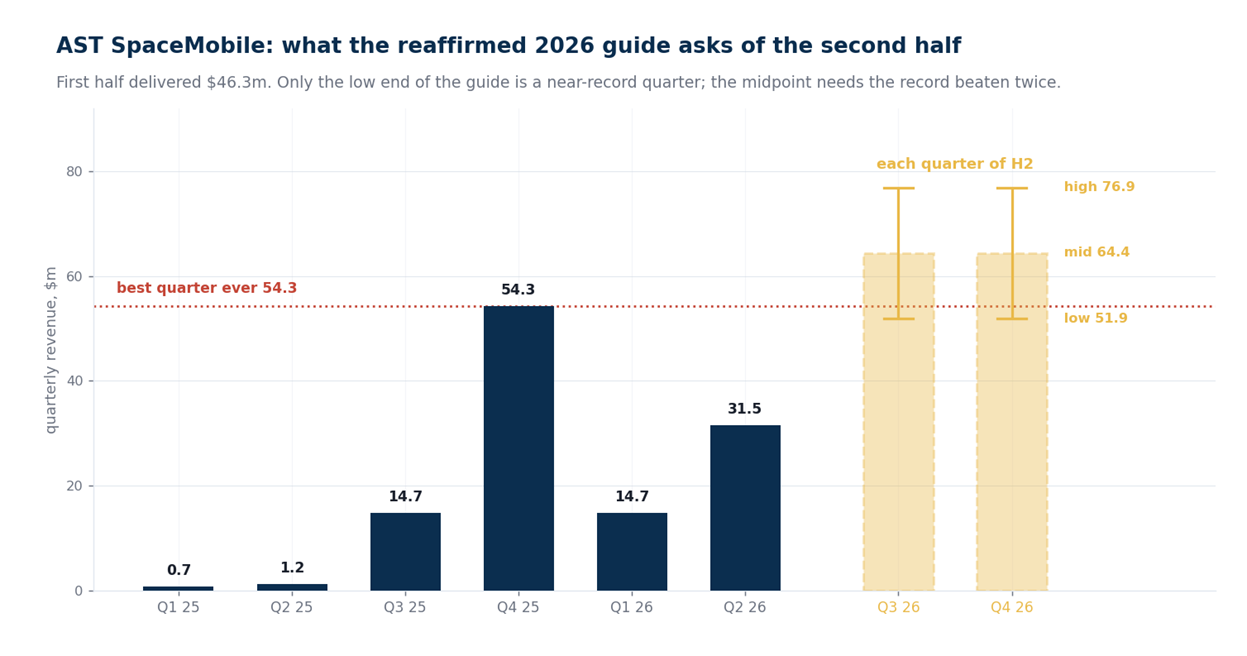
AST reported $14.7 million of revenue in March and $31.5 million in June, so $46.3 million in the first half, and reaffirmed full-year revenue of $150 million to $200 million. That leaves $103.7 million to $153.7 million for 2 quarters.
Put all 3 cases against the $54.3 million record, set in the final quarter of 2025. The bottom needs $51.9 million a quarter, 4.5% under the record. The midpoint needs $64.4 million, 18.5% above it. The top needs $76.9 million, 42% above. So the low end asks for 2 near-record quarters; the midpoint asks for the record beaten twice.
There’s a mechanism behind it. This revenue is lumpy and contract-shaped rather than recurring, drawn from roughly $1.3 billion of contracted commercial and government backlog, so it steps rather than compounds, and the $54.3 million quarter proves the step exists. But June came in at $31.5 million, below what analysts expected, and the run rate entering the second half sits far under what the guide needs. Backlog is a schedule, not a quarter.
The Financing Dependency
AST consumed roughly $1.37 billion of free cash across the 4 quarters through March, about $340 million a quarter, and adjusted operating expenses rose again in June, to $119.1 million from $91.2 million. In the March quarter it raised about $1.13 billion net across debt and equity.
At June 30 it held $2.29 billion of cash and equivalents, or $2.72 billion including restricted cash, against $2.96 billion of long-term debt. It’s net borrowed on either definition. In July it sold another $1.15 billion of convertible notes at 1.625%, lifting its own pro forma cash above $3.7 billion.
Be careful with that, because the obvious overstatement is that AST is about to run out of money. It isn’t. More than $3.7 billion against roughly $340 million a quarter is years of runway, and management says liquidity covers anticipated requirements for at least the next 12 months.
The accurate claim is narrower and still forceful. This network has been built on external capital rather than its own cash flow, and the economics stay sensitive to the cost of that capital until service revenue carries the load. That’s why Fed Chair Kevin Warsh signaling that inflation was back at the top of the agenda hit this name harder than most. A rate scare is a valuation input for most stocks. Here it reaches the funding of the asset.
Redwire Is the Control, Not the Comp
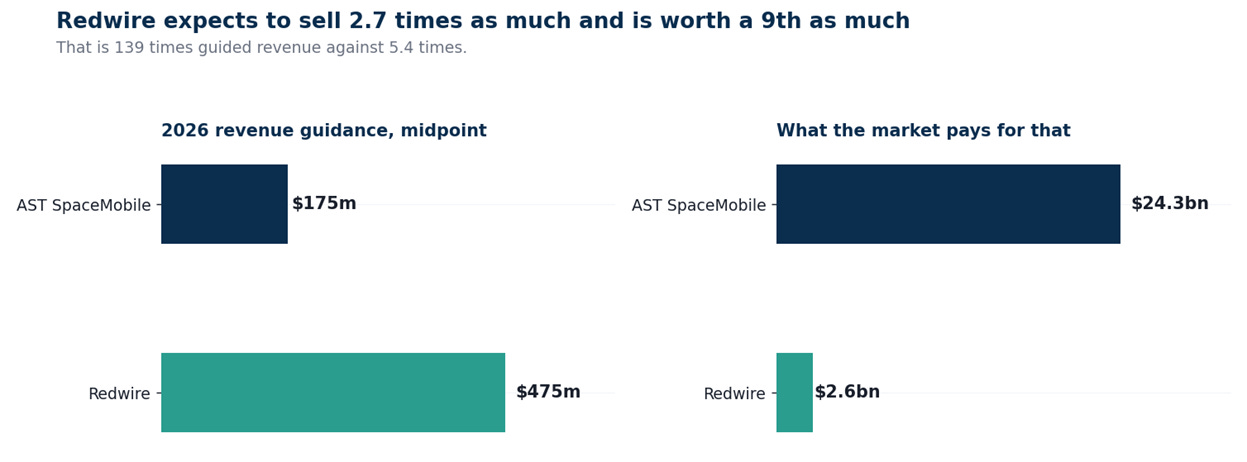
Redwire broke down the same week for none of the same reasons, and it’s here as the financing-risk control, not the valuation comparison. Nobody should argue it deserves AST’s multiple.
It did $214.0 million in the first half against guidance of $450 million to $500 million, so its second half needs 10% to 34% growth, and it puts visibility into that midpoint at 90% on record backlog of $542.1 million. It holds $557.0 million of cash plus restricted against $48.1 million of debt, close to 20% of its market value in net cash, and burned $35.3 million last quarter. It rose 24% across August, then gave ground into month end, closing at $10.33.
That’s the contrast. AST has vastly more upside if the network works. Redwire has vastly more room to be late. When what you own is an execution chain, the ability to absorb delay is worth something, and only one of these has it.
The Case Against Me
The counter that most threatens my argument is backlog. AST carries roughly $1.3 billion of it and booked over $125 million of new United States government awards in the June quarter. Converting $103.7 million inside 6 months is a scheduling question, not a demand question, which is why the guide is a stretch rather than a fantasy. But backlog converts on a timetable the company hasn’t demonstrated, and the first half converted $46.3 million.
The other counter is that I’m marking a venture asset against a revenue line that was never the point. If the constellation gets to 45 satellites and service starts, 2026 revenue becomes a footnote. More than 60 operator agreements across 3 billion subscribers is a distribution position nobody else has assembled, and AST really has shown broadband to an ordinary handset from orbit.
I accept most of that. This isn’t a short thesis and I’m not arguing the technology can’t work. My objection is to the trigger. A stock that can only be valued on execution ought to move on execution.
