


2 of the largest US aerospace and defense primes reported on the same morning and turned the rearmament thesis from a budget narrative into an operating-performance story: Lockheed’s revenue grew 10.5% with a record backlog and a $3B free cash flow swing, while RTX grew 16% organically with margins up in all 3 segments. Both stocks gapped higher and kept going. The same cycle now sells at 19x in one house and 30x next door, and that difference is what you’re actually choosing between.

One trades as a repair story. The other as a machine that must not miss.
Lockheed Martin and RTX reported second-quarter results on Thursday, July 23, and the market treated the pair as one event. Lockheed, the sector’s scarred laggard, beat across the major reported metrics and jumped 10.5%, then added 2.5% on Friday to close at $582.73. RTX beat and raised its core full-year guidance ranges, rose 7.3%, then extended the gain to a 52-week-high close at $212.84. Defense demand was already visible in order books before this week; Thursday made it difficult to dismiss on income statements. Prices below are based on the July 24, 2026 close; results are from both companies’ releases and calls.
Key Takeaways
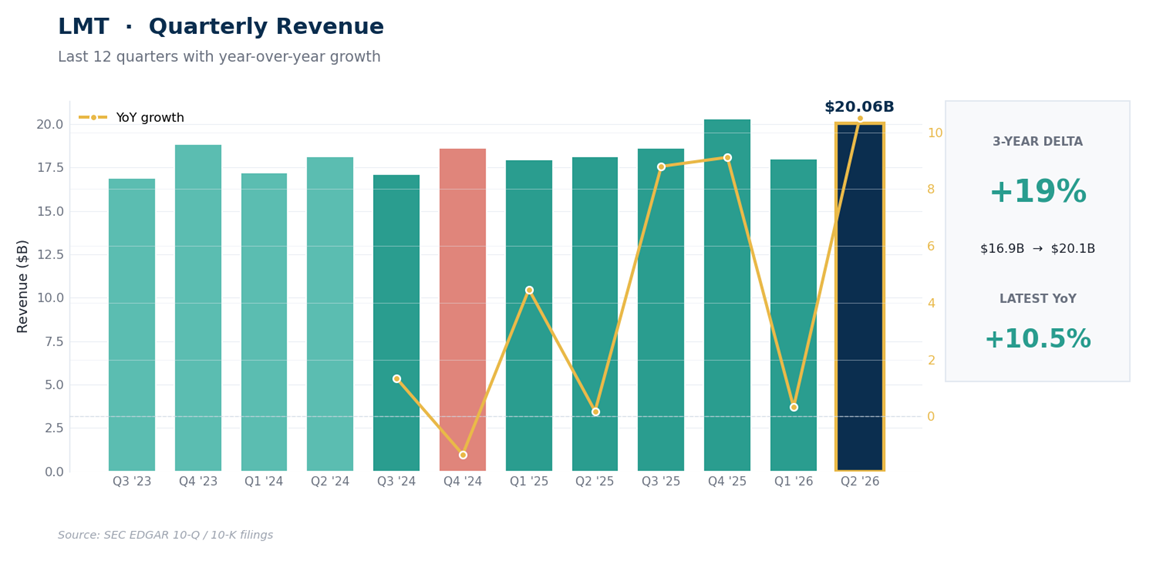
Lockheed: revenue up 10.5% to $20.1B, EPS of $7.94 about 10% above consensus, free cash flow of $2.9B versus negative $150M a year ago, backlog at a record $230B (up $64B from a year earlier), and the full-year guide raised to about 8% growth.
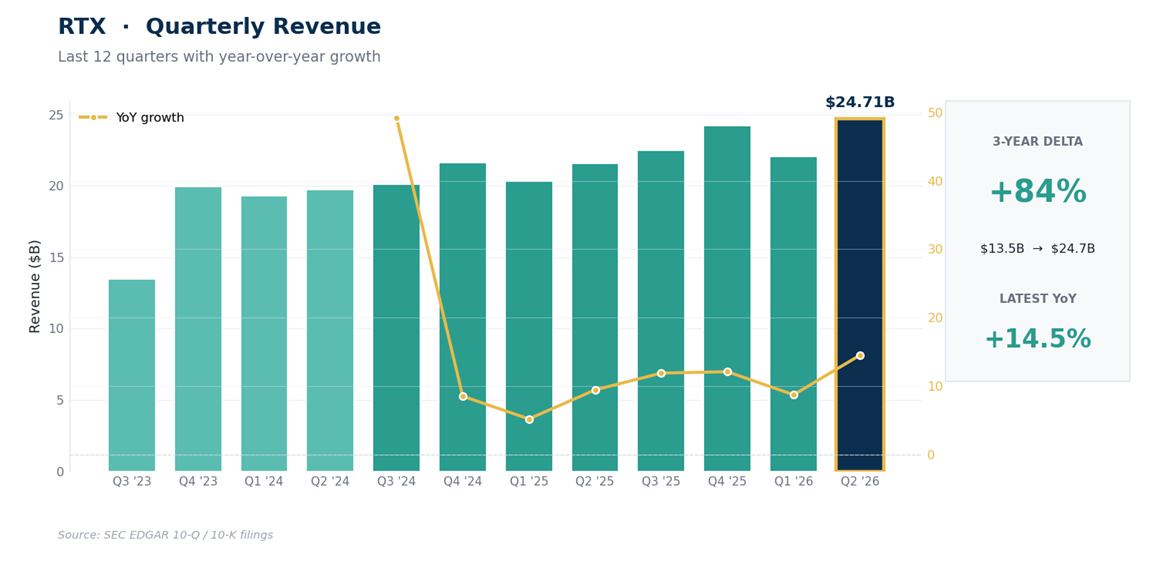
RTX: sales up 14% (16% organic) to $24.7B, adjusted EPS of $1.89 up 21%, margins expanded in all 3 segments, backlog of $289B split $170B commercial and $119B defense, and every core guidance line raised.
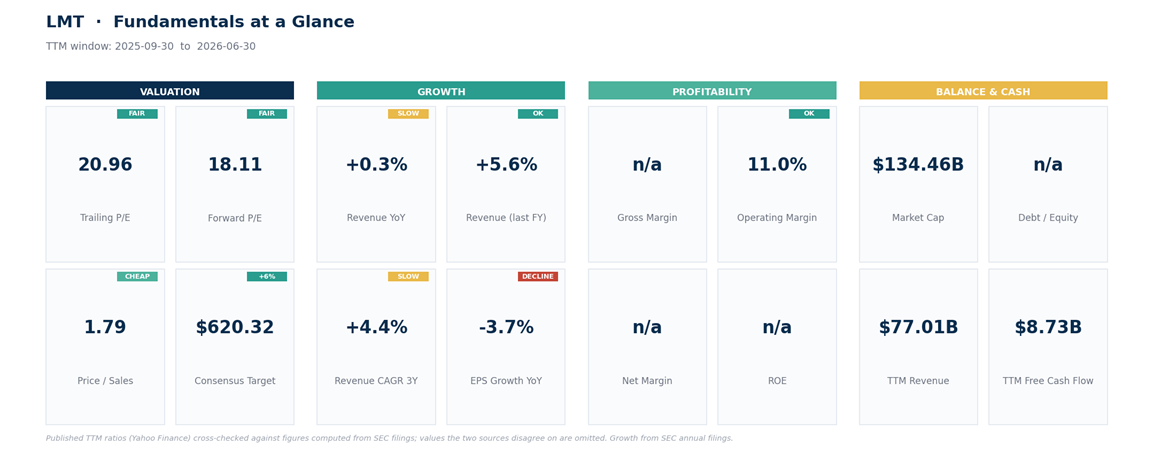
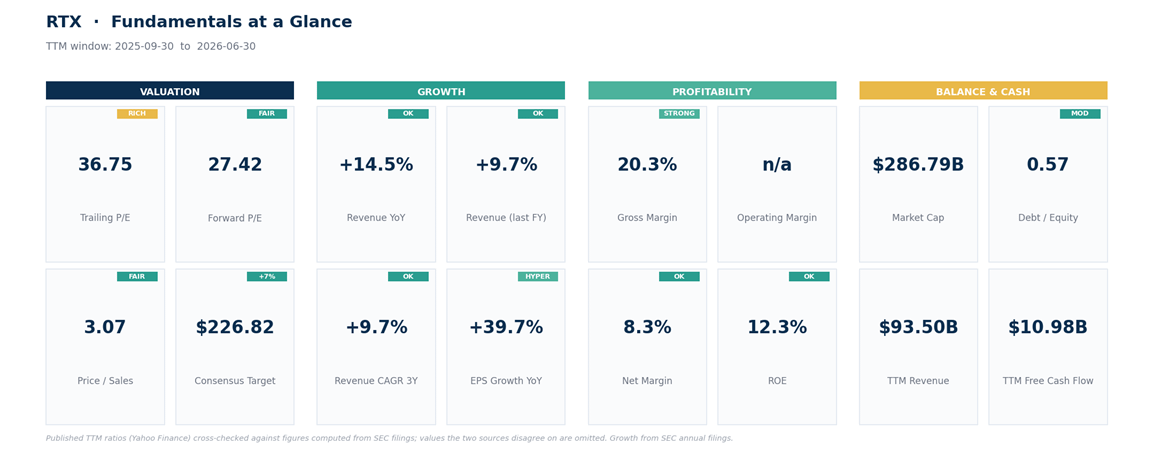
Valuation is the real story: Lockheed trades near 19x its raised guide, priced for skepticism after 2025’s charges; RTX trades near 30x, priced for execution, with part of the premium owed to its commercial aerospace engine. The multiples aren’t directly interchangeable, but the spread prices delivery risk.
The maps: Lockheed pullback zone 545 to 560, stop 528, breakout 589, references 614 and 692. RTX pullback zone 203 to 208, stop 194, breakout 215, references 227 and 237.
Lockheed: The Laggard Cashed Its Receipts
Lockheed entered the week as the cycle’s cautionary tale: a stock that peaked at $692 in the spring, fell as much as 30% as program charges and F-35 doubts piled up, and spent 3 months building a base in the low 500s while the rest of the sector rerated. Thursday’s print is why the base broke upward, and it wasn’t subtle. Revenue of $20.1B grew 10.5%, remarkable for a company whose recent norm was low single digits.
Earnings of $7.94 a share beat estimates by 10%, cash from operations hit $3.2B, and free cash flow of $2.9B compared with negative $150M a year earlier. Orders were the loudest number: $65B of them in the quarter, led by the $35B THAAD multiyear award, took backlog to a record $230B, roughly 2.9 years of revenue. Management raised the full-year sales guide to about 8% growth at the midpoint, up from 5%, and lifted the EPS range to $29.95 to $30.65.
One asterisk before admiring the 5x profit growth: the year-ago quarter carried $1.6B of program losses plus other charges, so the comparison flatters; it isn’t the real run rate of improvement. The honest read is the level, not the growth rate: a 12.4% margin in Missiles and Fire Control, positive cash, and a raised guide are what a cleaned-up Lockheed looks like, and the market’s question, after 2025’s charge parade, is simply whether clean quarters can repeat. That question is also why the stock is cheap: at $582.73, Lockheed trades near 19x the midpoint of its own raised guide and about 18x next year’s consensus, still 19% below its $692 spring record.
RTX: The Compounder at Full Price
RTX’s quarter was broader and, in margin terms, better. Sales of $24.7B grew 16% organically, and all 3 segments expanded margins while growing double digits in their key lines. Raytheon, the defense segment, grew 18% with operating profit up 29% on Patriot, Standard Missile, and AMRAAM volume, the clearest rearmament receipts in either report. Collins grew 8% with commercial original equipment up 26%. Pratt and Whitney grew 16% with the commercial aftermarket up 25% and military engines up 23%. That mix is the point of RTX: a $289B backlog that’s $170B commercial and $119B defense, 2 cycles pulling in the same direction at once. Free cash flow was $2.9B in the quarter, and organic growth is now guided to 8 to 9% versus 5 to 6% before.
The asterisk here runs the other way. GAAP EPS of $1.57 sits well below the $1.89 adjusted figure, and the trailing GAAP P/E of 36.8x makes the stock look absurd; that number doesn’t describe current economics, it reflects old charges. The cleaner anchor is still not cheap: at $212.84, a fresh 52-week-high close, RTX trades near 30x the midpoint of this year’s raised adjusted guide and about 27x next year’s consensus. The premium over Lockheed is the price of the commercial aerospace engine and a decade of steadier execution. It’s earned, and it leaves less room: at 30x, quarters like this one are the expectation, not the surprise.
Same Cycle, 2 Prices
Put the prints side by side and the sector question writes itself. Both companies just proved the demand. What differs is what each price already assumes. Lockheed at 19x its own guide is priced for skepticism, the residue of 2025’s charges, which means a second consecutive clean quarter does more work for the stock than another THAAD-sized order would. RTX at 30x is priced for execution, which means it doesn’t get the benefit of low expectations: the commercial aftermarket and the margin expansion have to keep compounding just to hold the multiple.
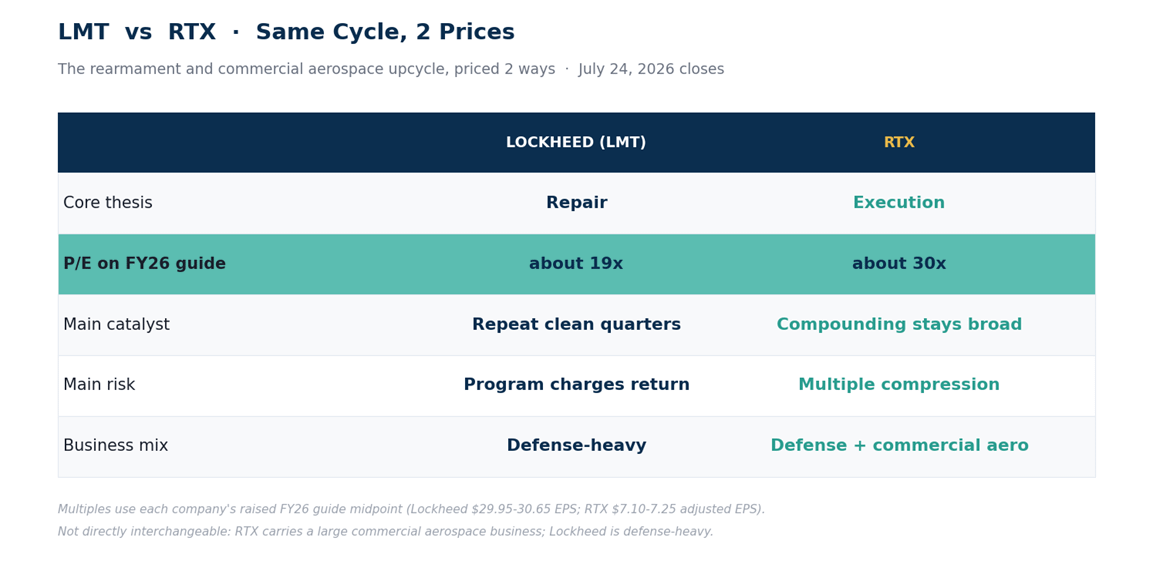
One qualification keeps the comparison honest: these multiples aren’t directly interchangeable, because RTX carries a large commercial aerospace business and a stronger recent execution record, while Lockheed is defense-heavy with fresher scar tissue. The spread still tells you how differently the market prices delivery risk in the same upcycle. Neither is wrong; they’re different bets on the same rearmament and commercial aerospace cycle, and Thursday rewarded both, one as a repair story, one as a confirmation story.
The Maps
One possible framework, not a promise. Both stocks just gapped up hard and closed above their upper volatility bands with momentum readings overbought (RSI 72 for Lockheed, 74 for RTX). That’s strength, not a signal to chase: post-earnings gaps in this sector frequently retest their origin.
Lockheed, daily timeframe, all triggers meaning daily closes.
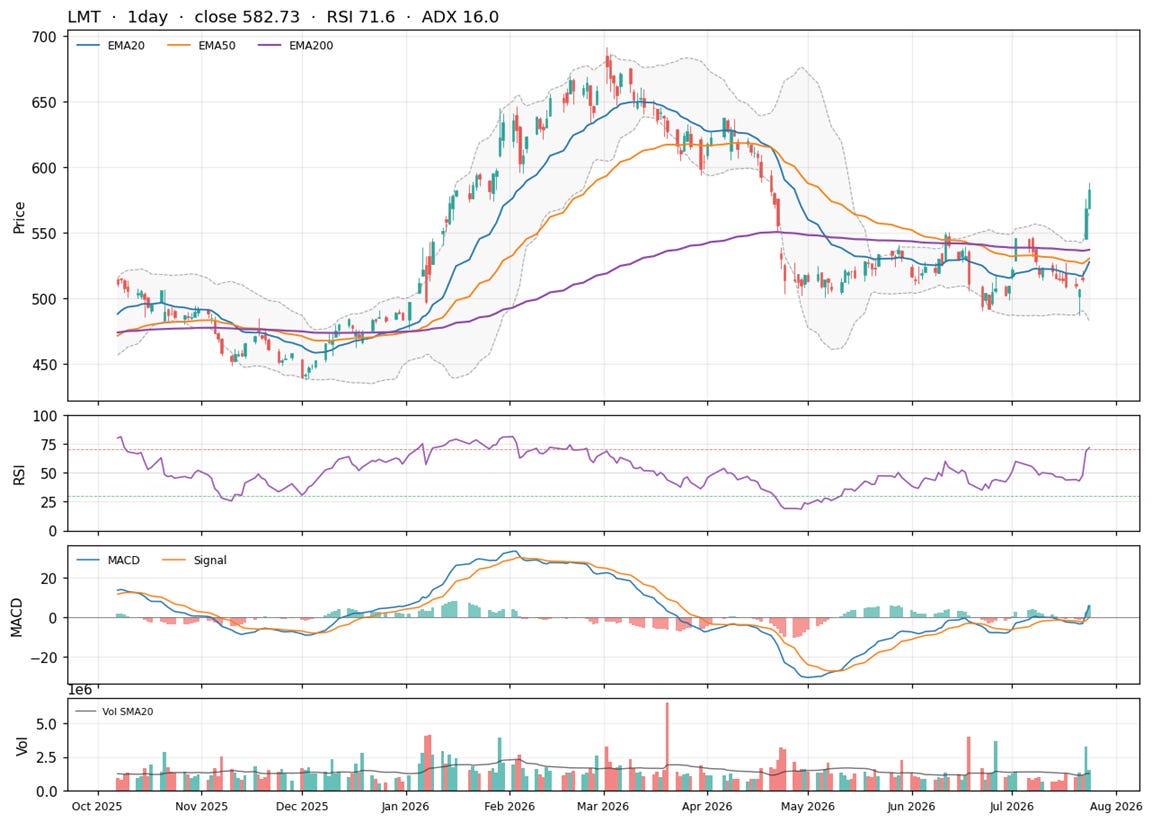
Pullback zone: 545 to 560, the earnings-day launch area (Thursday opened and bottomed at $545) just above the reclaimed moving-average cluster.
Stop: a daily close below 528, back inside the pre-earnings gap and below the summer shelf. That close would mean the rerating failed.
Breakout: a daily close above 589 clears Friday’s $588.41 high and the halfway mark of the whole spring decline, opening 614, the 61.8% retracement (the $620 analyst mean is a secondary reference nearby), and the 692 record.
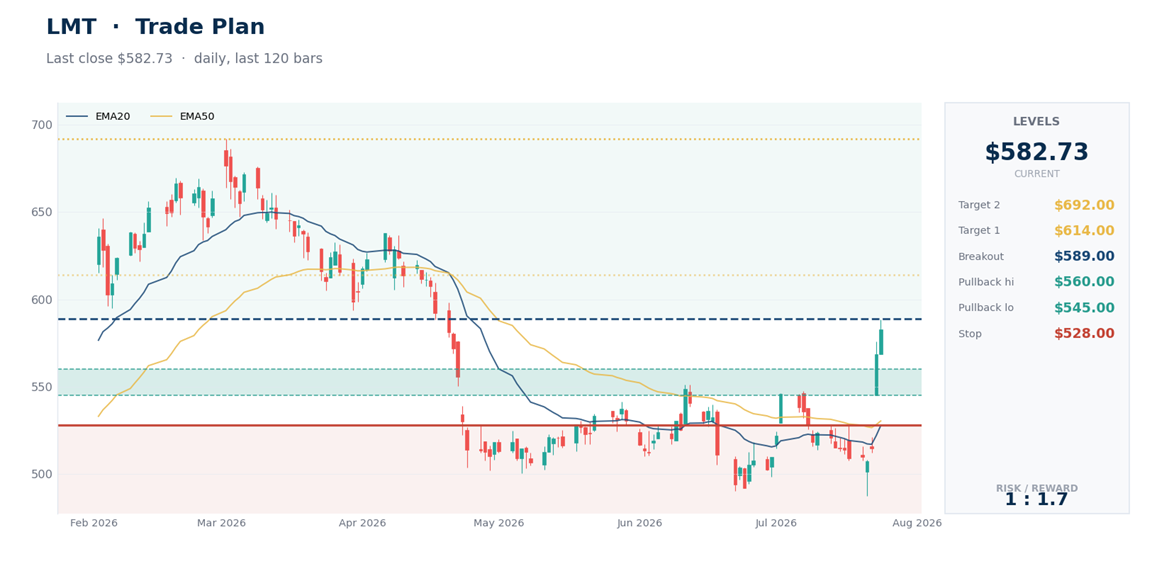
For fresh capital (illustrative): a fill near 552 against the 528 line risks about 4.4%. Size the position so a full stop-out stays inside your predetermined portfolio risk budget, and remember this name just moved 13% in 2 sessions.
RTX, daily timeframe.
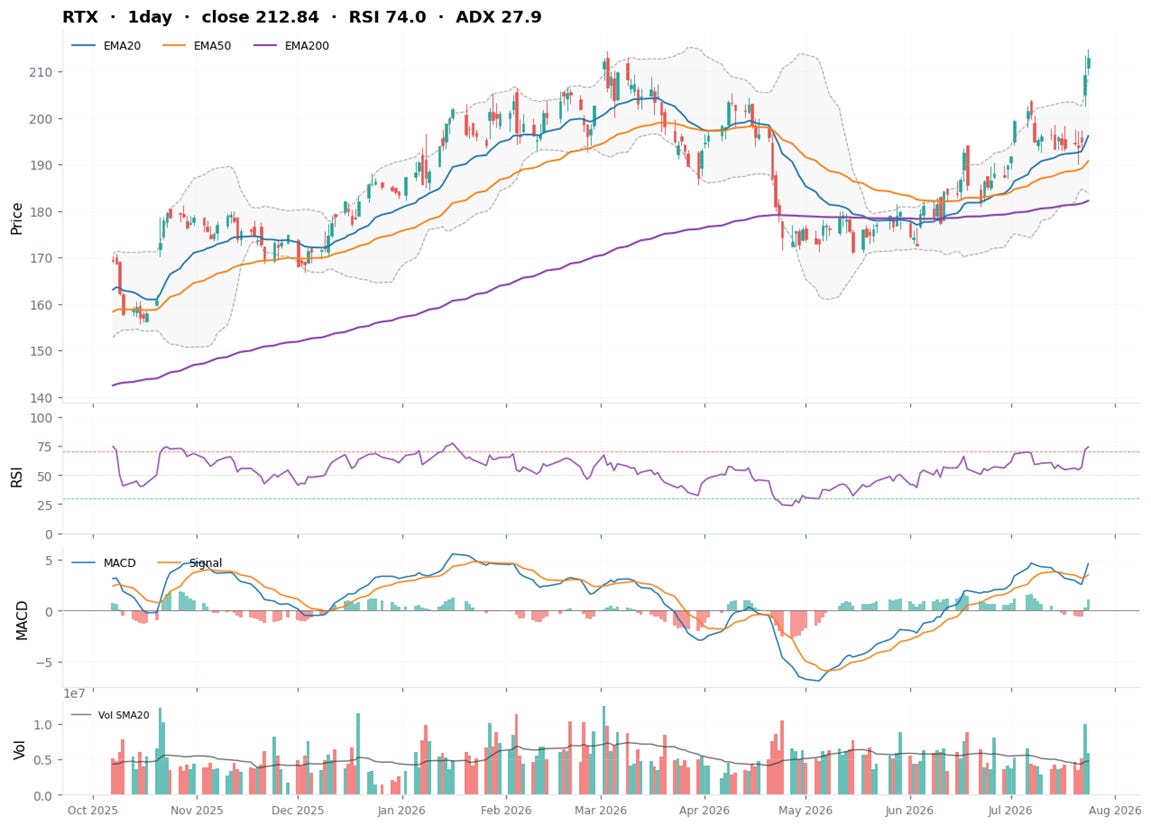
Pullback zone: 203 to 208, Thursday’s gap-day range and the top of the old June-July consolidation.
Stop: a daily close below 194, the pre-earnings close. That would fully unwind the reaction and put the stock back inside its old range.
Breakout: a daily close above 215 clears Friday’s 52-week high at $214.89 into territory with no price structure above it, which leaves only secondary references: 227, the analyst mean, and 237, the median target.
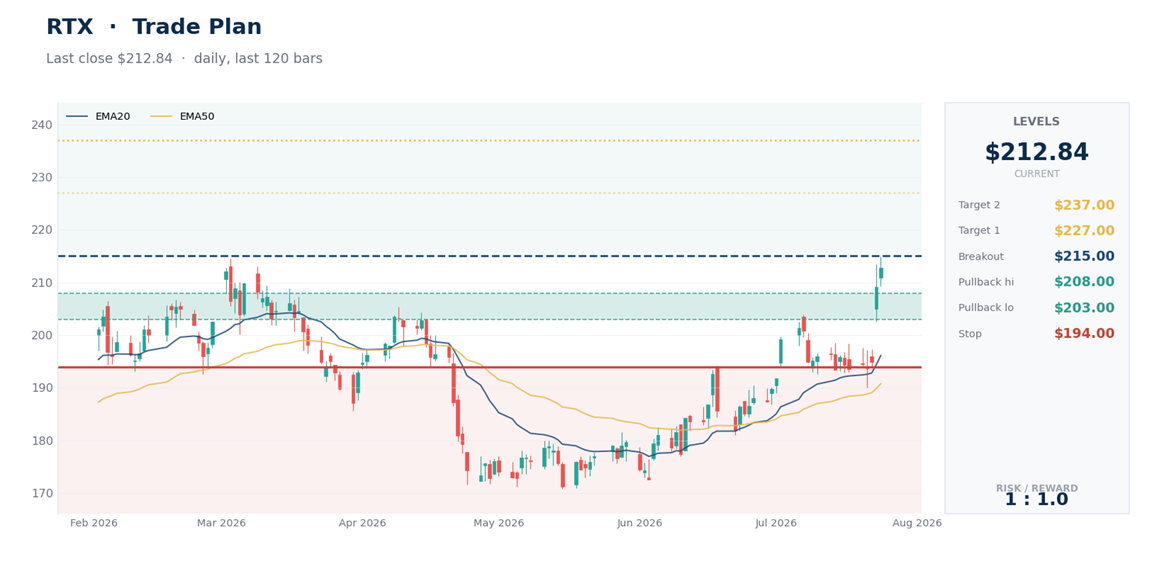
For fresh capital (illustrative): a fill near 205 against the 194 line risks about 5.4%; the same risk-budget rule applies. The 215 breakout route pays a worse price for confirmation and should carry its own stop back under 208.
Both companies’ next reports are expected in late October; between now and then the evidence is award announcements, European order flow, and whether the gaps hold.
Bottom Line
Thursday settled the demand question; the receipts are in both reports. What it didn’t settle is the price of belief. Lockheed offers more rerating room if the execution stays clean, and 545 to 560 is where that bet gets its first test. RTX offers the stronger operating machine at a price that already assumes continued delivery, with 203 to 208 the disciplined entry if the gap retests. The cycle is no longer the debate. The debate is whether you’d rather buy recovery at 19x or execution at 30x.
This is research and commentary, not personal investment advice. Levels and trade plans are illustrative; size positions to your own risk tolerance and time horizon. The author may hold positions in names discussed.