One must justify a premium built on AI compute after a 41% fall from its June record. The other must prove that Apple-related decline is not permanent while trading at 15.5x forward. They report the same evening, Wednesday, July 29 after the close, they remain courtroom adversaries, and together they mark the 2 extremes of what the market will pay for semiconductor earnings.
One is priced for the future of compute. The other is priced for decline.
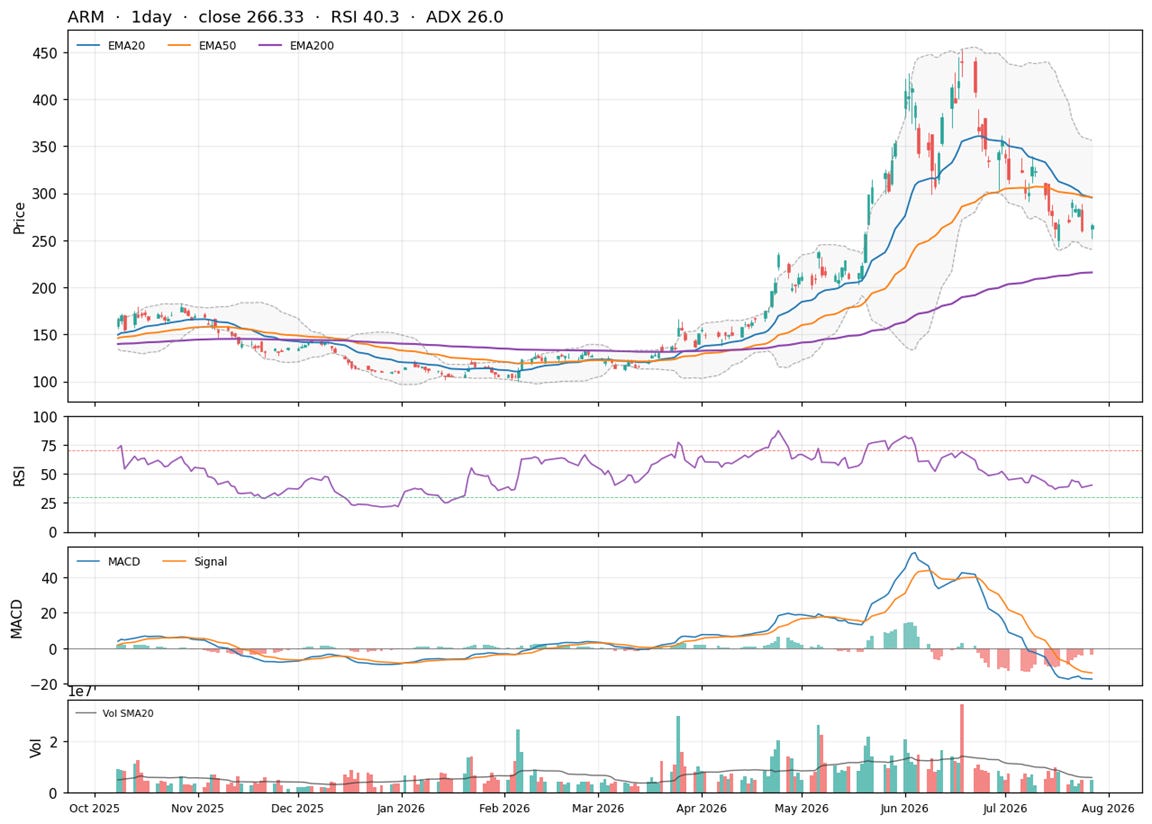
Wednesday after the close is the most crowded reporting slot of the season: Microsoft and Meta take the headlines, and underneath them, the 2 poles of the chip trade report side by side. ARM closed Monday at $266.33, down 41% from the $452.70 record it set on June 18, caught in the July semiconductor selloff with an FTC licensing probe and analyst target cuts along the way. Qualcomm closed at $170.04, 35% below its May high, cheap on most screens and unloved on most of them. Prices below are based on the July 27, 2026 close; estimates are from Street previews and prior guidance.
Key Takeaways
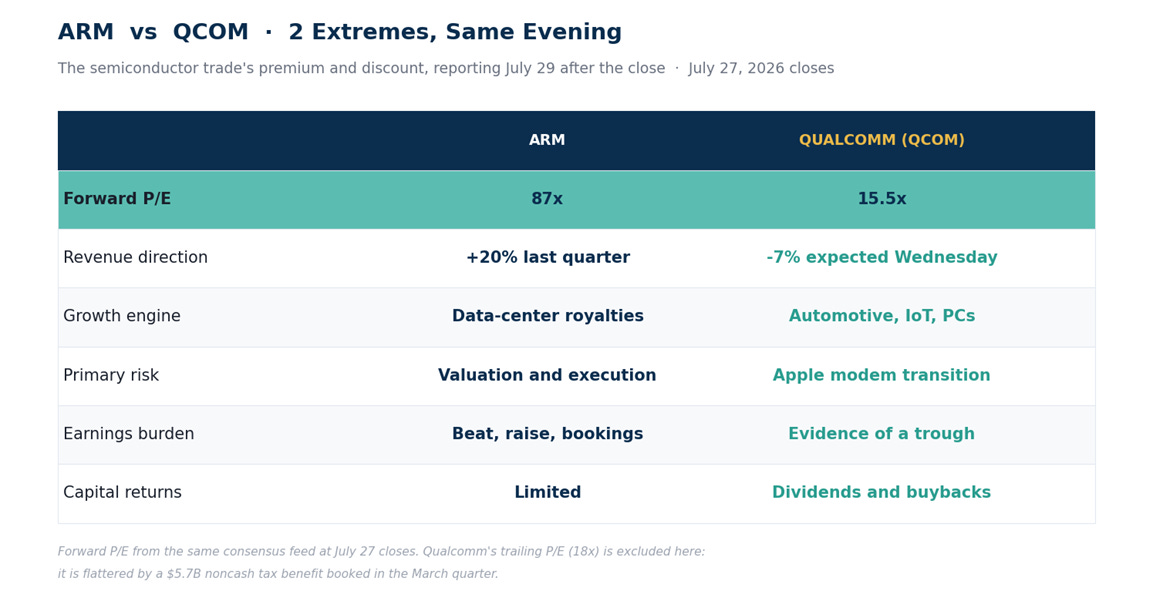
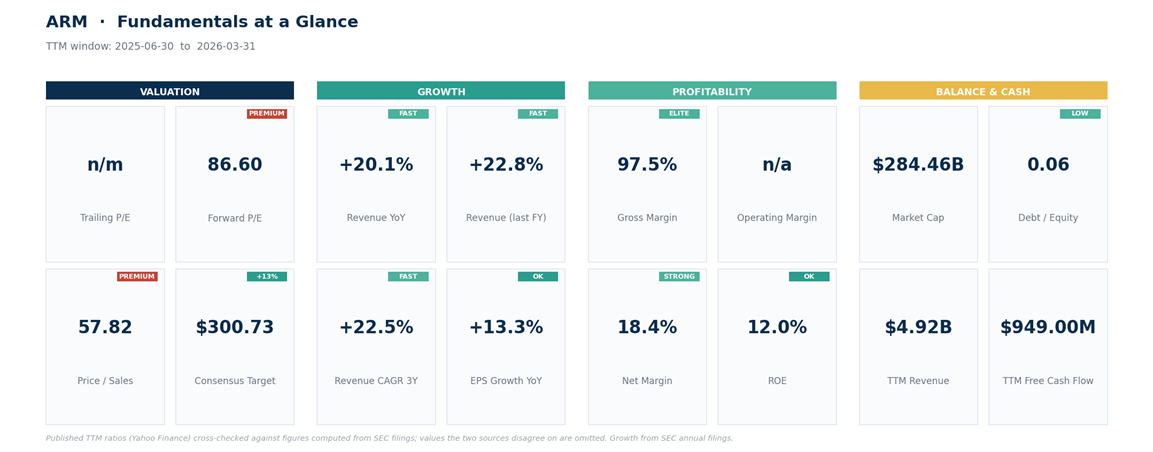
ARM’s premium survived a 41% drawdown: at 87x forward earnings and roughly 60x trailing revenue, the price still assumes royalty growth on the AI buildout, where data-center royalty revenue has been doubling and ARM-based compute has reached about half the CPU share at top hyperscalers.
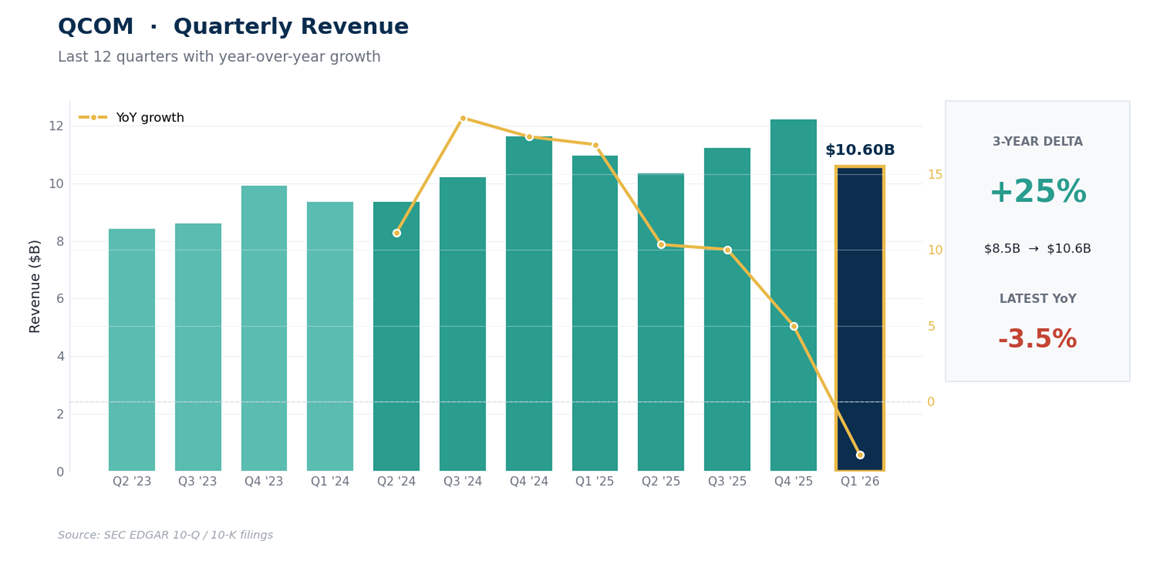
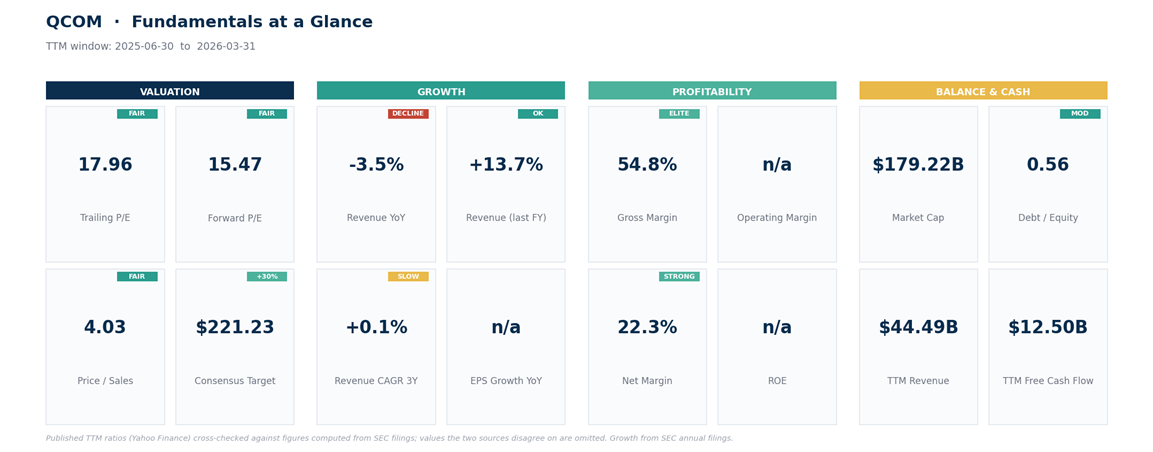
Qualcomm’s discount assumes decline: 15.5x forward with Wednesday’s consensus near $9.6B to $9.7B of revenue, down about 7%, a second straight decline as Apple’s in-house modem ramps, while automotive grows about 50% underneath.
The asterisks run in opposite directions: ARM’s 303x trailing P/E reflects GAAP earnings still small next to its market value, while Qualcomm’s 18x trailing P/E is flattered by a $5.7B noncash tax benefit booked last quarter. The forward multiples, 87x and 15.5x, are the cleaner comparison.
The maps: ARM gap-zone 240 to 252, invalidation 232, repair 296, references 318, 356, and the 452 record. Qualcomm support 163 to 167, invalidation 158, repair 181, references 191 and 207.
ARM: The Toll Booth After the Fall
ARM designs the architecture underneath an unusually broad share of the world’s compute, from smartphones and embedded devices to a rapidly growing footprint in hyperscaler data centers, and collects licensing and royalty revenue on most of it.
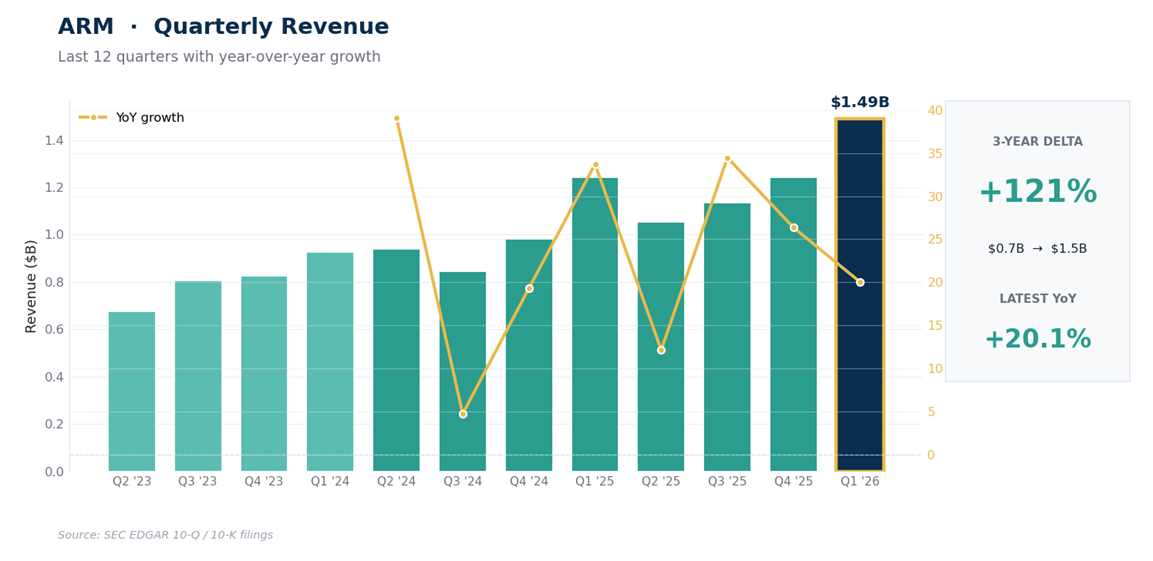
That’s what the multiple pays for. Data-center royalty revenue has been roughly doubling year over year, ARM-based CPUs have reached about 50% share of compute shipped to top hyperscalers, and CEO Rene Haas has confirmed more than $2B of customer demand for its new AGI data-center CPU across fiscal 2027 and 2028, double the figure announced at launch, with Meta, which reports the same evening, as lead co-developer. The March quarter grew revenue 20% to $1.49B, and Wednesday’s job is to validate the $1.26B first-quarter guide and keep the bookings story moving.
The AGI CPU deserves a caveat as well as applause. Selling complete silicon is a departure from the royalty model: it can expand ARM’s revenue dramatically, and it also adds manufacturing, inventory, and execution exposure the company has never carried, while putting it in more direct competition with the licensees its neutrality was built on. That tension is part of what the FTC is reportedly examining.
The market spent June paying for the opportunity without the complications; the 41% decline since had 3 authors: the sector selloff that took roughly $1.3 trillion out of semiconductor value in July, the FTC investigation reported in May, and analysts trimming targets even as the stock rose into June. What remains is a valuation that is still extreme, 87x forward, with a Street that can’t agree on what the company is worth: targets run from $125 to $500, and the median at $260 now sits below the price. Options price an 11% move on the report, per data compiled by Bloomberg.
Qualcomm: The Cash Machine Priced for Decline
Qualcomm is the inverse. The market knows exactly what’s wrong: Apple is ramping its own modem, handsets are Qualcomm’s biggest business, and Wednesday’s consensus expects revenue near $9.6B to $9.7B, down about 7%, the second consecutive decline. At 15.5x forward, 35% below its May high, the current multiple implies the decline is the whole story. It isn’t.
Automotive revenue set a record at $1.33B last quarter, up 38%, and management guided the June quarter to roughly 50% automotive growth; the diversification into cars, IoT, and PCs is real and compounding. The company has beaten EPS estimates 4 quarters running, and unlike ARM it returns capital along the way, through dividends and buybacks. The bar Wednesday is not greatness; it’s evidence the declining segment is troughing while the growing ones scale.
One accounting note before trusting the screens: Qualcomm’s 18x trailing P/E is flattered, not strained. Last quarter’s $7.4B of GAAP net income included a $5.7B noncash income-tax benefit from the release of a valuation allowance, which makes trailing earnings overstate the recurring run rate. The forward multiple of 15.5x, built on estimates that exclude it, is the cleaner valuation anchor. The analyst mean of $221.23 sits 30% above the price, and Qualcomm’s target range clusters tightly where ARM’s spans 4x from bottom to top. The Street broadly agrees this business is worth more; the price says investors want proof first.
The Lawsuits Between Them
The 2 reports share a legal backdrop worth stating precisely, because it’s widely misreported. The dispute now runs on 2 distinct tracks. ARM’s original case over Qualcomm’s Nuvia-derived designs was resolved at the trial-court level in Qualcomm’s favor in September 2025; ARM has appealed.
Separately, Qualcomm’s own claims against ARM, over licensing practices, contractual obligations, and alleged anticompetitive conduct, are expected to go to trial in the fourth quarter of 2026.
The remaining legal risk is therefore less about a shutdown of Qualcomm’s Oryon roadmap, which the trial court has already declined to order, and more about ARM’s pricing power, its licensing conduct, and the future economics of the relationship, questions the FTC is circling from its own direction. Neither call is likely to say much Wednesday, but any settlement signal would move both stocks.
The Maps and the Earnings Plan
One possible framework, not a promise. Wednesday grades each name against its own bar, not against the other: ARM at 87x needs a beat, a raise, and booking momentum, and an in-line quarter at that multiple tends to be treated as a miss. Qualcomm needs much less: revenue troughing on schedule and automotive delivering its guided growth. Both are binary events with closing-basis triggers, and gaps can move through any level. A methodology note: the volatility bands below are Bollinger bands (2 standard deviations around the 20-day average), and the daily-range figures are 14-day average true ranges as a % of Monday’s close, ARM near 9.6%, Qualcomm near 5.8%, both measured across the July selloff.
ARM, daily timeframe, all triggers meaning daily closes.