


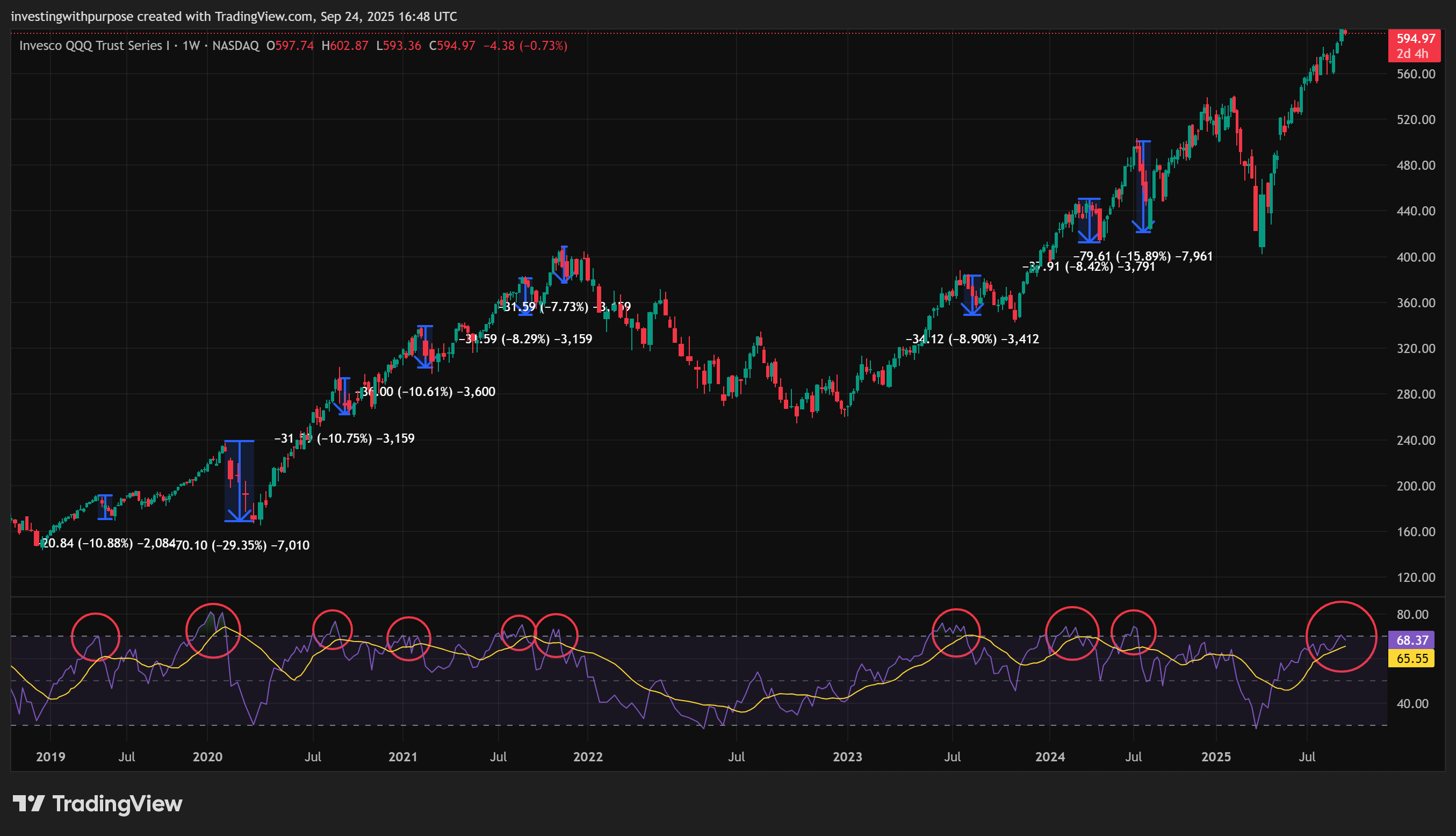
We’ve been staring at the same picture you are: a weekly QQQ chart pressing fresh highs, with RSI living in the high-60s/low-70s and a string of prior “red-circled” overbought tags that coincided with tidy 6–16% pullbacks. It’s the kind of chart that feels great until it doesn’t. Let’s unpack the setup, then layer in the very latest macro and earnings context to build a short-term and medium-term playbook that’s balanced, not breathless.
Key Takeaways
Short term (2–6 weeks): Risk of a shakeout/consolidation is elevated (weekly RSI stretched, sentiment warming, seasonality, data catalysts). A garden-variety 5–10% QQQ drawdown would be perfectly consistent with the past three years’ rhythm.
Medium term (3–6 months): The backdrop still skews constructive if disinflation holds enough for the Fed to keep easing and EPS trends keep grinding higher, especially with AI capex still compounding. Upside likely resumes after corrections, but with fatter tails around policy/data surprises.
What The Chart is Telling us
On the weekly QQQ chart, the RSI has pushed into the “hot zone” again, clustering near ~68–70 with a rising price structure. The pattern we’ve highlighted in red circles on prior RSI spikes; lines up with a familiar sequence:
Momentum surges, RSI tags ~70+
Breadth narrows and leaders (semis, mega-cap platforms) start to chop
A 6–16% reset or multi-week sideways range bleeds off excess, then the uptrend resumes
None of this is predictive on its own, but it is probabilistic. Stretched weekly momentum rarely resolves by going vertical for months on end; it usually cools. Context matters, so let’s bring in the new macro and earnings tape.
What Changed in the Last Two Weeks (and Why It Matters)
1- The Fed just cut and signaled more cuts are probable
On Sept 17, the Fed lowered the policy rate by 25 bps to 4.00%–4.25%, its first cut of 2025, and flagged that additional easing this year is likely. One voter (Miran) preferred a 50 bps move. The statement explicitly notes downside risks to employment have risen.
Interpretation: Easing supports multiples and duration-heavy growth (read: QQQ), but the Committee is also telling us the economy has cooled enough to warrant cuts. That two-sided message can keep volatility alive: good for risk assets overall, but sensitive to each data print.
2-Inflation: CPI re-accelerated a touch; PCE is next
August CPI rose 0.4% m/m and 3.6% y/y a tad hotter than the prior month. Core disinflation remains slow.
The PCE release (the Fed’s preferred gauge) is due next, with previews looking for core PCE ~0.21% m/m and ~2.7% y/y.
Interpretation: If PCE behaves, the Fed’s “more cuts this year” path stays intact. If it doesn’t, markets will start second-guessing the glide path, cue chop.
3- Growth pulse: manufacturing still recessionary, jobs mixed
ISM Manufacturing backlog and new orders remain weak; August PMI sub-50, backlogs contracting for the 35th straight month.
Weekly jobless claims fell to ~218k, nudging markets to reassess just how fast the Fed will cut.
Interpretation: The soft-manufacturing/hard-services split persists. A still-resilient labor market complicates the Fed’s easing tempo.
4- Earnings: estimates trending up into Q3
FactSet puts Q3 S&P 500 EPS growth at ~7.7%, up from 7.2% at quarter start; Financials led the latest upward revisions.
Broader context: Y/Y growth has returned after last year’s EPS recession; IT/Communication Services still the growth engine.
Interpretation: As long as the estimate trend holds, pullbacks in price should be opportunities, not regime changes.
5- AI capex and leadership: still the story, still crowded
Nvidia news flow remains dominant (analysts projecting massive multi-year AI spend; targets rising), while hyperscaler/AI-infrastructure tie-ups (e.g., CoreWeave-OpenAI) keep reinforcing the capex cycle narrative.
Interpretation: The capex impulse is intact. Leadership breadth beyond the “Magnificent Many” is the variable to watch.
6- Rates, oil, and volatility
10-yr yields have chopped in the low-4s; the market is hypersensitive to each macro print and Powell soundbite.
Oil has been whippy (stockpile surprises sent prices to a 7-week high, then faded intraday). Energy is not the immediate tailwind it was in 2022, but spikes still threaten the inflation narrative.
VIX is mid-teens (~16), historically calm but with “fall seasonality” notorious for shake-ups.
7- Flows & sentiment
AAII bullish readings bounced to ~41.7%, with bears still elevated (~42%). Not euphoric, not depressed; just… split.
Reuters notes renewed U.S. equity inflows after a summer detour abroad and tech-led leadership wobble; still, investors fade rallies when the Fed’s path gets questioned.
Short-Term Playbook (2–6 Weeks)
What’s priced:
A gentle easing cycle (two more 25 bps cuts in 2025) and soft-landing-ish growth.
Modest earnings acceleration in Q3 with AI still the engine.
What could go wrong (near-term):
PCE/CPI miss: A hot PCE or sticky core inflation keeps the Fed cautious; multiples compress at stretched RSI.
Macro surprise: A sharp re-acceleration in oil or upside surprise in rates tilts the tape risk-off.
Policy friction: U.S. government shutdown risk adds headline volatility and delays data; markets hate uncertainty.
What could go right (near-term):
Goldilocks prints (cooling PCE, steady jobs): validates the cut-and-coast path.
Earnings pre-announcements skew positive: buffers any multiple pressure.
AI capex cadence stays relentless (contracts, capacity builds): keeps leadership intact.
Tactical take:
With weekly RSI stretched and VIX subdued, the path of least resistance is a shakeout or sideways digestion. Think -5% to -10% in QQQ or a 3–6 week range that lets the moving averages catch up. That’s been the recurring pattern when the red circles have appeared.
Into weakness, favor laddered entries in structurally advantaged names (AI infrastructure, high-quality platforms with rising EPS revisions). Hedge tactically (defined-risk puts or collars) around macro dates (PCE/ISM/claims, FOMC minutes).
Medium-Term Playbook (3–6 Months)
Base case (probability >50%):
The Fed cuts one to two more times by year-end as growth cools but avoids a hard landing; PCE drifts around ~2.5–3%.
EPS keeps trending higher into 2026; capex cycle for AI/infrastructure remains the dominant multi-year force.
Outcome: After a consolidation/correction, trend resumes with shallower advances and frequent rotations (semis → software/services → “picks & shovels” like networking and custom silicon).
Bull case (probability ~25%):
PCE glides closer to 2.3–2.5% by winter; the Fed accelerates cuts (labor softening but orderly). Multiple expansion resumes, breadth improves, and small/mid caps catch a bid as financing costs fall.
Bear case (probability ~25%):
Inflation re-flares (oil/shipping/tariffs), or growth deteriorates faster than the Fed can respond, or policy risk (shutdown, trade) bites. Fed hesitates, yield curve re-steepens bearishly, EPS revisions stall. A >12–15% index drawdown would be on the table.
Levels & Risk Framing (QQQ)
First line: The rising 10–12 week MA (weekly trend support). A break typically ushers in a 6–10% swing-low search.
Second line: Prior breakout shelf (the last weekly consolidation high). Retests here are common during digestion phases.
Invalidation (for the medium-term bull): A decisive weekly close below the shelf and falling EPS revisions would argue a regime shift rather than a shakeout.
What we’re watching each week:
PCE/CPI + claims: confirm the Fed’s room to cut without re-stoking inflation.
EPS revisions: especially outside the AI core, does breadth in upward revisions improve?
Rates & VIX: 10-yr back above ~4.4% with VIX <14 is a pressure combo for longs; VIX >20 on a benign macro print can be a buy-the-fear tell.
Flows/sentiment: AAII around 40–45% bulls with bears still >35% = room both ways; extremes are what we fade.
AI tape health: contract flow (CoreWeave/OpenAI et al.), hyperscaler commentary, and supplier guideposts (NVDA/AVGO/AMD) as a proxy for capex cadence.
Positioning bias:
Short term: Respect the heat. Keep gross a notch lower than usual or hedge around data dates. Fade chasers; buy the second down day, not the first pop.
Medium term: Lean into quality compounders and AI infrastructure on weakness; add selectively if PCE behaves and revisions stay green.
A Note on Seasonality & “October Jitters”
Volatility often picks up into fall, and even Goldman is waving the “don’t get lulled by calm” flag. Seasonality isn’t destiny, but it does raise the odds of a shake. Keep dry powder ready.
This analysis is for informational purposes only and not investment advice.