


Microsoft trades at 19.7x forward earnings, 31% below its record. Meta trades at 16.1x forward, 25% below its record, after 7 straight losing sessions. Both report Wednesday, July 29 after the close, and both discounts trace to the same doubt: whether next year’s AI capex earns a return. Cheap is real here. Whether it’s a gift depends on the spending guides.

Cheap is a price. The question is the bill.
Both companies report Wednesday, July 29 after the close, and both arrive under pressure. Microsoft finished Friday at $381.70, 31% below its $555.45 record, and remains below every major moving average after falling as low as $349.20 in June. Meta finished at $595.19, down 7 sessions in a row and 25% off its $796.25 record, a dollar above the invalidation line of the framework we published on July 19.
The season has already taught the rule: Alphabet grew 24% last week and still got sold, because the same release raised its capex guide. The market isn’t grading growth this summer. It’s grading the bill. Prices below are based on the July 24, 2026 close; estimates are from Street previews and prior company guidance.
Key Takeaways
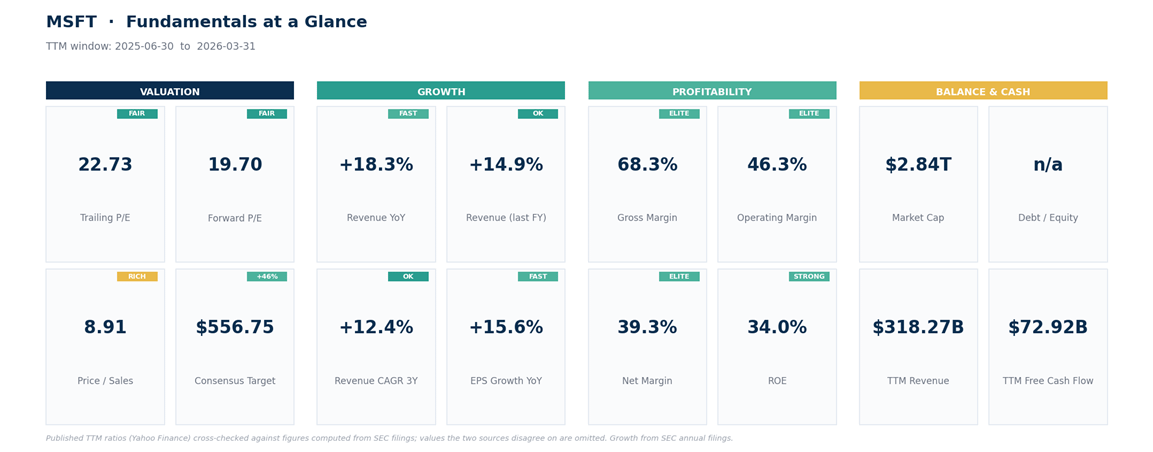
Microsoft is historically inexpensive at 19.7x forward, and the discount has named causes: roughly $72B of capex in its fiscal first half, slow Copilot monetization, and OpenAI concentration in the backlog.
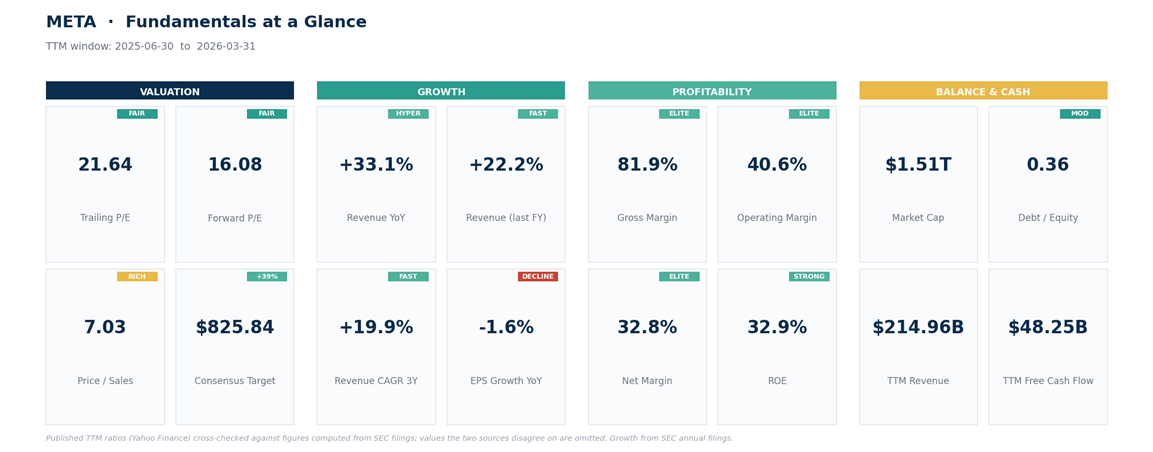
Meta at 16.1x forward is now cheaper than Alphabet despite growing 33% last quarter at a 41% operating margin; another raise of the $125B to $145B capex range could overwhelm whatever the quarter itself says.
Wednesday’s reactions will likely turn more on the spending guides, Microsoft’s first fiscal 2027 capex framing and Meta’s range, than on the reported quarters. Azure’s bar: 39% to 40% guided, with expectations near 36%.
The maps: Microsoft support 365 to 375, invalidation 348, repair 408, references 422 and 466. Meta gap-zone 540 to 555, invalidation 518, repair 622, references 645, 686, and 744.
Microsoft: The Frightened Compounder
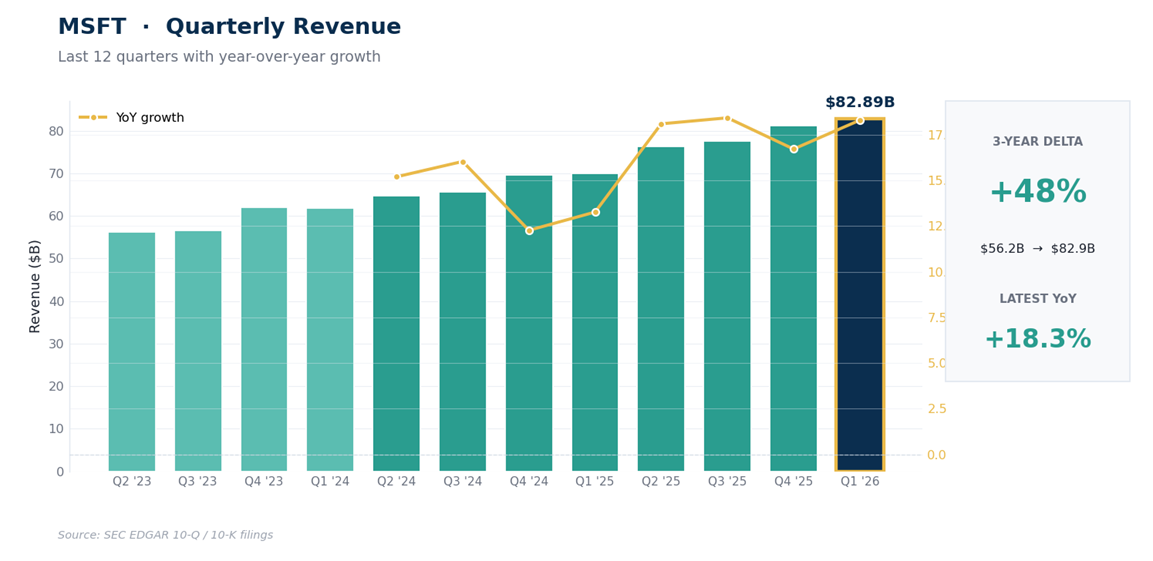
We haven’t covered Microsoft before, so start with what the market did to it. From a $555.45 record, the stock was repriced in stages all year, hardest in June, when it broke from $466 to $349 in under 4 weeks. The complaints are specific. Capex ran about $72B in the first half of fiscal 2026, and Wednesday brings the number the whole AI trade is waiting for: the first framing of fiscal 2027 spending.
Copilot revenue is growing more slowly than the invested capital implies it should. And the backlog carries concentration risk: outside analyses have estimated that roughly 45% of the $627B commercial backlog traces to OpenAI, a customer actively spreading its compute across other clouds. Microsoft doesn’t disclose the split.
What the repricing ignored is that growth hasn’t actually slowed much. The March quarter grew revenue 18% with net income up 23%, and Wednesday’s consensus, near $87.7B of revenue and $4.24 of EPS, implies about 15% growth at a $350B run rate.
Azure is guided to 39% to 40% constant-currency growth, with expectations closer to 36%. At 19.7x forward earnings, a below-historical multiple, investors are paying for a company still producing mid-to-high-teens growth, priced as if the growth were ending, because the return on capex now annualizing near $145B isn’t visible yet.
The analyst mean of $556.75 sits 46% above the price. Targets lag and drift, so treat them as sentiment rather than valuation; even so, a gap that wide measures the mood.
Meta: The Framework at Its Line
Our July 19 piece mapped Meta in detail at $658 and told readers that entries before the report “deserve half size, and gaps can run losses past plan.” Score it honestly: the preferred zone at 630 to 638 filled on July 20 and broke 2 days later, the secondary zone at 603 to 612 gave way by Friday’s close, and Friday’s $595.19 sits $1.19 above the framework’s invalidation, a daily close below 594, with Friday’s low at $594.45.
That line is being tested now, 2 days before the report. Anyone who took the half-size advice is glad they did; the zone entry is down about 6% with the decision point underfoot.
The pressure here is about credibility as much as arithmetic. Meta’s capex guide of $125B to $145B was already raised once, from $115B to $135B, and 7 straight down sessions into earnings say the market is pricing the risk it rises again. A JPMorgan downgrade and cautious notes about strategy sprawl, Llama, Reality Labs, Quest, superintelligence hiring, did the rest.
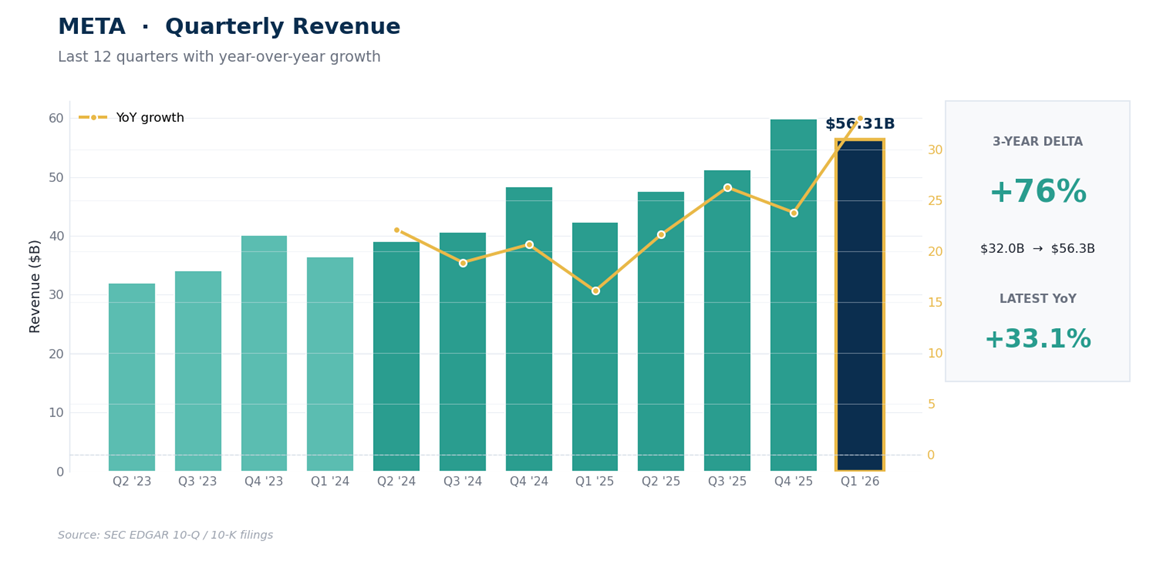
Underneath, the ad engine keeps working: 33% revenue growth last quarter at a 41% operating margin, with Meta’s AI ad products still lifting measured conversion. Even on estimates that assume growth slows from here, the stock trades at 16.1x forward, now below Alphabet. The Street’s mean target of $825.84 is 39% above the price.
Cheap, Yes. The Catch Is the Conditional.
On the numbers, they’re cheap, and not subtly: 2 of the best businesses ever built at 19.7x and 16.1x forward, each 39% to 46% below where the analysts who model them think they’re worth. But the cheapness isn’t a market error; it’s a market condition. Both multiples embed the fear that AI spending keeps growing faster than AI revenue, and last Wednesday showed how that fear trades: Alphabet accelerated to 24% growth, raised its capex guide to $195B to $205B, and fell anyway. Cheap can stay cheap for a long time if the spending guides keep surprising.
That turns “is it a buy” into a checklist. For Microsoft: Azure at or above its guide, a fiscal 2027 capex frame that comes with margin protection language, and any progress diversifying the backlog beyond OpenAI. For Meta: the ad metrics holding, and one sentence mattering more than any other, whether the $125B to $145B range survives the call intact. If those clear, the discounts are opportunity. If they don’t, they were justified.
The Maps and the Earnings Plan
One possible framework, not a promise. Both are binary events: Microsoft fell 5% on its January report and Meta fell more than 6% after April’s, both short-term momentum gauges are pinned at oversold, and no stop below can promise protection against an overnight gap, because every trigger here is a daily close. Positions carried into Wednesday accept that.
Microsoft, daily timeframe, all triggers meaning daily closes.
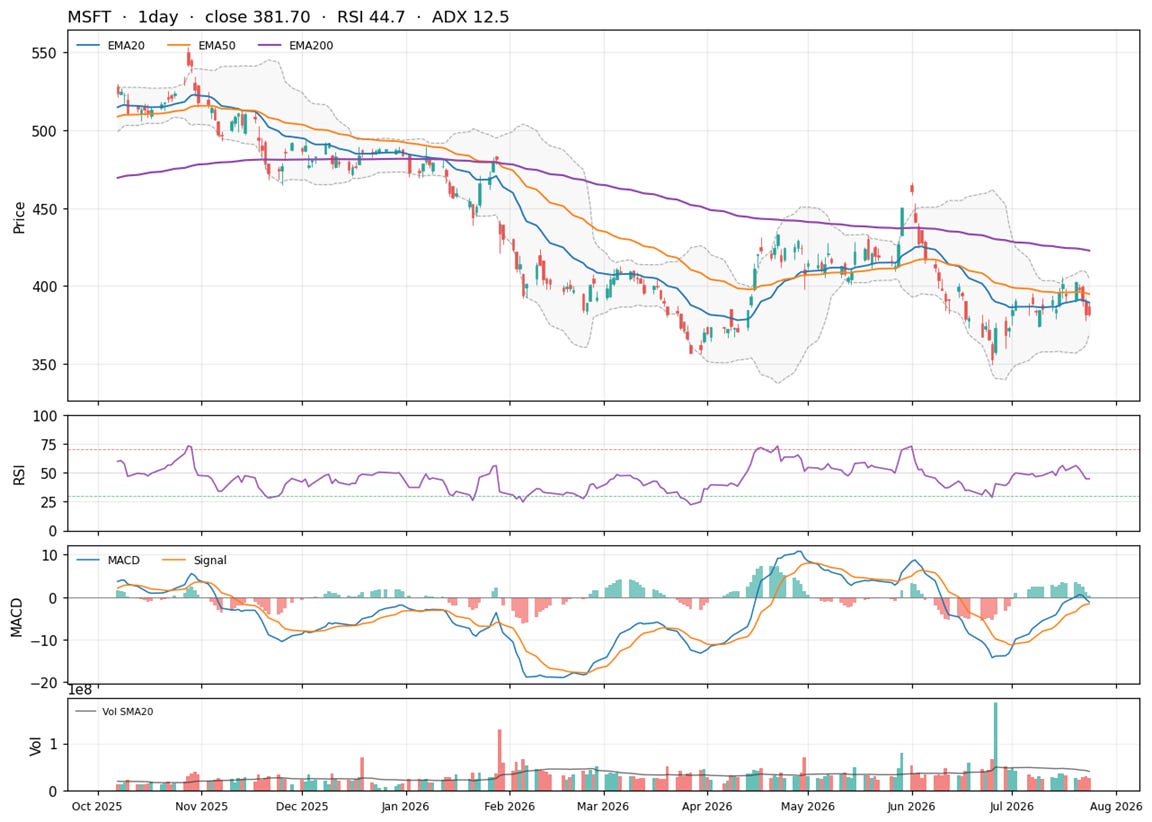
Support zone: 365 to 375, the lower volatility band near 369 and the shelf between the June low and the bounce.
Invalidation: a daily close below 348, under the June 25 low of $349.20, which is also the 52-week low. Below that, the repricing has entered a new leg and the cheap argument needs a lower price to be true.
Repair: a daily close above 408 clears the July recovery high ($405.99) and the halfway retracement of the June break at $407.76 in one move, with references at 422 (the 200-day average and the 38.2% retracement, just over a point apart) and 466, the June high.
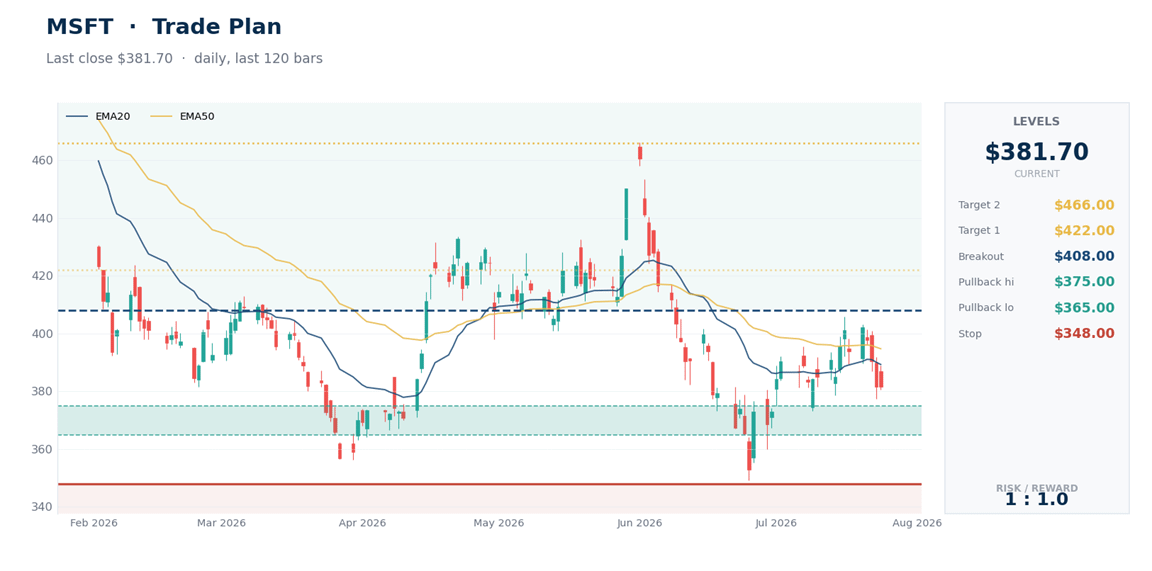
For fresh capital (illustrative): the distance from a $370 fill to the 348 line is about 6%, but realized loss can exceed it, since the trigger is closing-basis and earnings gap. Size so a 10% gap against you stays inside your portfolio risk budget, or wait for the report.
Meta, daily timeframe. The July 19 invalidation at 594 still governs existing positions: a daily close below it, before or after the report, formally ends that framework.
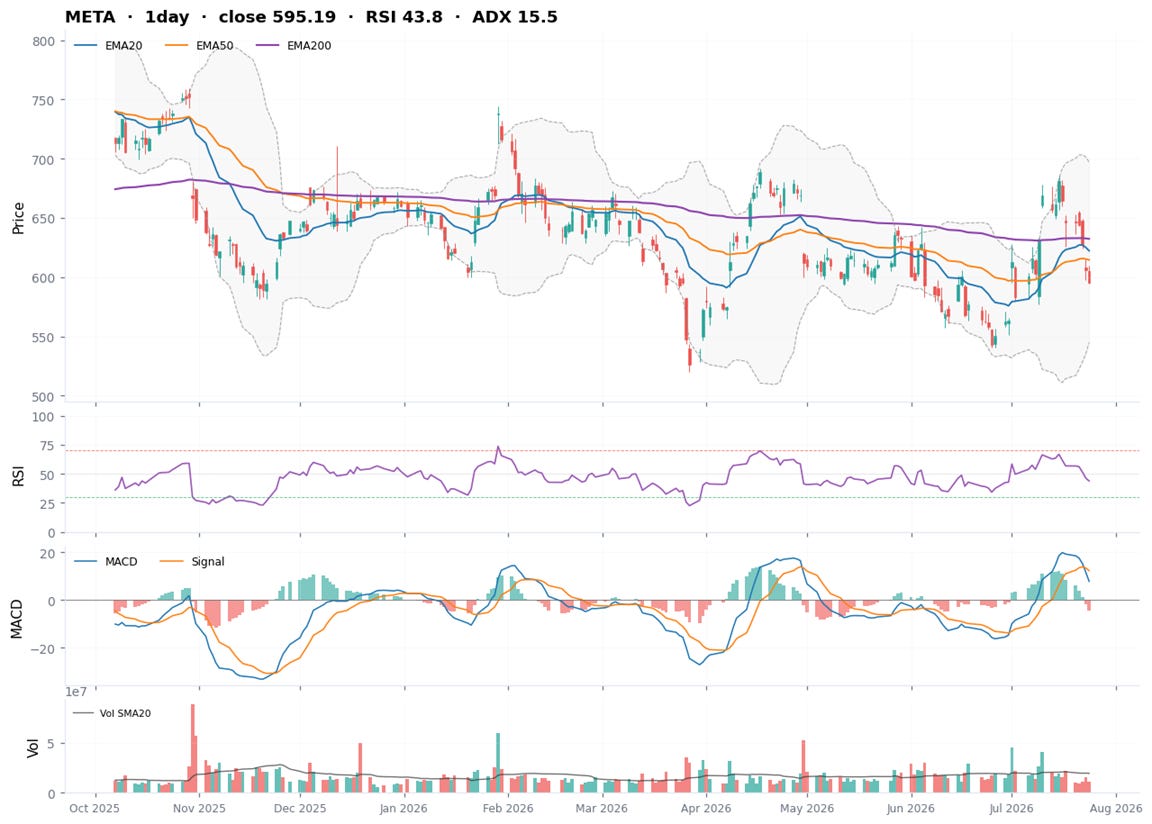
Gap-zone: 540 to 555, the June 25 low ($540.18) and the lower volatility band. That’s where a bad-reaction gap has structure to land on; it’s a post-earnings reaction zone, not a pre-earnings entry.
Invalidation: a daily close below 518, under the 52-week low of $520.26. Below that, the 2-year uptrend structure is gone entirely.
Repair: a daily close above 622 reclaims the cluster where the 20-day and 100-day averages and the halfway retracement stack between 620 and 623, with references at 645 (the pre-slide shelf), 686 (the July high), and 744 (the April high).
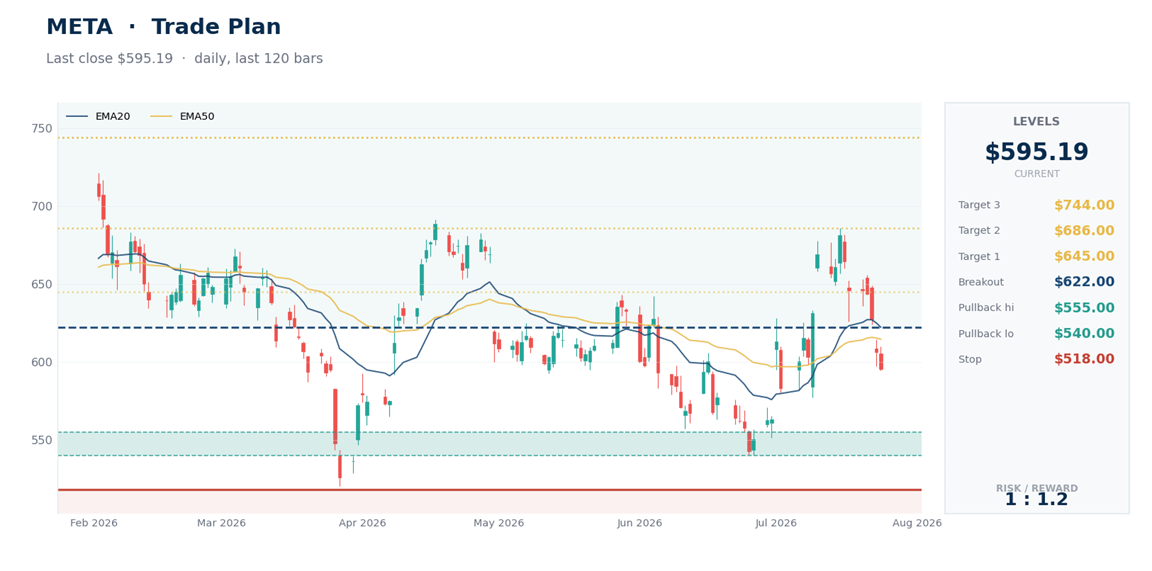
For fresh capital (illustrative): there is no clean pre-earnings entry here; price is pinned to a decision line the night before a binary event. The disciplined routes are both post-report: a hold of 540 to 555 on a bad reaction, or the 622 repair on a good one. Either way, size against the next level down, not against hope.
Bottom Line
Both stocks are cheap because investors no longer give AI spending the benefit of the doubt. Wednesday shows whether that skepticism has gone far enough. For Microsoft, the answer hangs on Azure and the first fiscal 2027 spending frame; for Meta, on whether the current capex range holds. Until those answers arrive, the discounts are real, but so is the reason for them. React at the levels above, not before them.
This is research and commentary, not personal investment advice. Levels and trade plans are illustrative; size positions to your own risk tolerance and time horizon. The author may hold positions in names discussed.