


META 0.00%↑ reported a stellar revenue quarter, but the stock didn’t love it. Why? Because underneath the headline growth lurked a massive one-time tax charge, and a warning of far higher spending ahead. For long-term investors, the question isn’t just “did Meta grow?” but “do we trust it will turn its big investments into lasting returns?” Over coffee, let’s walk through what we know, what we don’t, and how you might thoughtfully position if you like the risk-reward.

Key Takeaways
Meta delivered $51.24 billion in Q3 revenue (+26% YoY). The Guardian
EPS came in at $1.05, massively below expectations, due to a ~$15.9 billion one-time tax charge. Investopedia
Ex-that charge, revenue and income were very strong, suggesting the core business is firing. PR Newswire
Meta is projecting much higher expenses in 2026, particularly for AI infrastructure and employee compensation. AP News
The stock dropped ~9% after the release, investors are wrestling with “good growth but heavy cost” and long-term return doubts. Business Insider
For a medium-to-long term investor, the path is less about waiting for the “bottom” and more about entering with conviction when risk is clearly defined.
Business & Pipeline: What Meta Really Has Going On
Meta isn’t just Facebook anymore. The business is large, diversified, but also in the middle of a reinvention.
Ad platform growth: Revenue continues to climb strongly. In Q3, the +26% YoY number shows that despite mature scale, Meta is still growing the core engine. The ads business remains robust.
User scale and monetization: The “family of apps” (Facebook, Instagram, WhatsApp) boasts ~3.54 billion daily active users. AP News Monetization per user (ARPU) is rising, not just user count, which matters.
AI + infrastructure investment: Meta is front-loading significant capex and operating investments to become a leader in “frontier AI.” That drives revenue potential, but also cost and risk. investors.com
Reality Labs / devices: This is still a drag. Meta’s hardware/VR/AR unit is large, loss-making, with long payoff horizons.
Regulatory & business model risks: Especially in Europe, ad-targeting, data consent issues, and regulation (DMA, etc.) add headwinds. Traders Union
What it means:
Meta’s core ad business is extremely strong, this gives the company a powerful base from which to invest. The critical question is whether the large and rising investments in AI and infrastructure will pay off in a time-frame that matters to investors, and whether the regulatory/business model risks will remain manageable.
Fundamental Analysis: The Good and the Caution
The Good:
Growth: +26% revenue in Q3 signals Meta is not stagnating.
Margin: Even with rising costs, operating margin remains healthy (in the 40% range). investor.atmeta.com
Balance sheet: Cash flow and liquidity remain strong, giving Meta optionality.
Scale: Few companies have Meta’s size, ad-network reach, and user base, that’s a durable competitive advantage.
The Caution:
One-time tax hit of ~$15.9 billion (Q3) skewed EPS from ~$7.25 (ex-charge) down to ~$1.05. PR Newswire
Capex / expense ramp: Meta says expenses will grow even faster in 2026 than 2025. The higher cost base increases break-even risk and means the “payoff” phase of the investment is pushed forward. AP News
FCF yield appears modest given size and risk, the current valuation assumes a lot of optionality.
Competition and regulation: Ad-economics could be compressed, especially internationally or via privacy/reg changes.
Is the drop an overreaction?
In my view: partially yes, partially no.
Yes: The core business beat expectations; the revenue number is very strong. The tax hit is one-time, not recurring (assuming Meta’s guidance holds). The sell-off seems more about “fear of cost” than “failure to grow.”
No: Because investors are rightly asking: “Will these big investments deliver?” The warning of higher costs in 2026 raises legitimate concerns. In other words, the drop reflects not a crisis, but increased uncertainty and markets hate uncertainty.
So if you believe Meta will monetize its AI and maintain ad growth, the drop likely offers a good entry over time. If you’re sceptical about the ROI of its investment spree or concerned about regulation compressing margins, the risk is underappreciated.
Trade / Investment Plan: Medium-to-Long Term
Goal: Own Meta’s compounding ad machine and optionality from AI, while controlling cost/risk.
Sizing: Consider starting small and scaling in as clarity improves.
Entry Strategy:
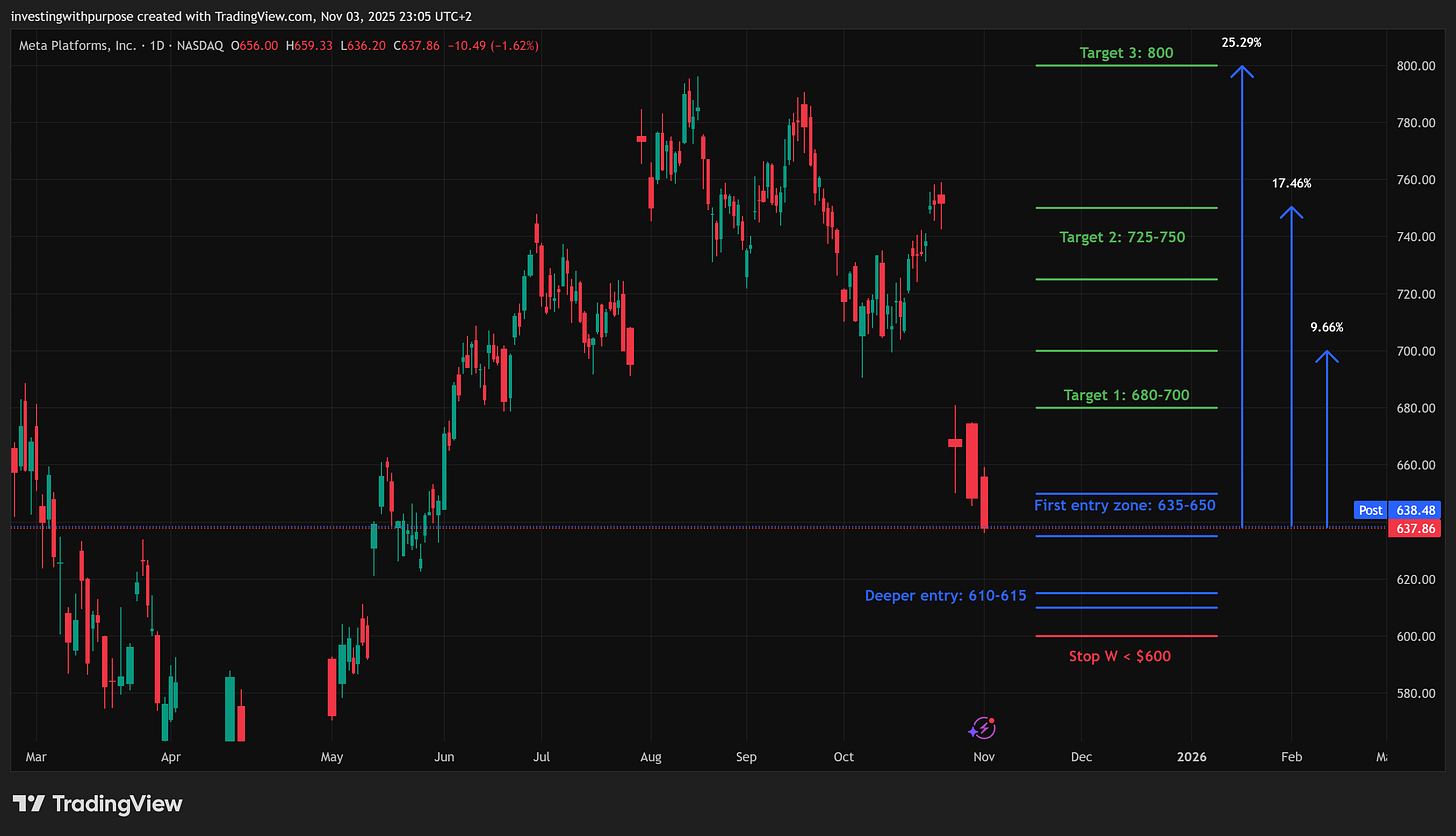
Primary buy zone: $635–$650 – current correction zone after ~15% drop.
Secondary buy zone: $610–$615, or on a deeper flush toward ~$603.
Confirmation signal: See a daily reversal candle in the buy zone + improving momentum (RSI up, MACD shrinking red).
Stop / Invalidation:
If Meta closes weekly below $600, the support breaks and I’d exit (or drastically reduce) because risk-reward deteriorates.
For the initial entry zone ($635–$650): tighter stop could be daily close below ~$610.
Profit / Target Strategy:
Trim 1/3 at $680–$700 (resistance cluster, 200-day MA).
Trim another 1/3 at $725–$750 (Fib/MA cluster).
Hold a core for stretch toward $750–$800 or higher if fundamentals improve meaningfully.
Why this approach:
Allows you to participate after a significant pullback while acknowledging risk.
Keeps your downside limited (via stop) but allows upside if Meta executes.
Gives you “optional” premium: if core business holds and AI begins to pay, upside is meaningful; if not, you limit losses.
Bottom Line
Meta stands at a fork: its advertising engine is firing and still growing strongly, giving the company a robust foundation. But it’s also paying the freight for the next decade with massive infrastructure, talent, and data-center bills. The recent drop is not a sign the business is broken, rather it’s a sign of investor discomfort with the timing of returns and scale of investment.
For a medium-to-long term investor who believes Meta can convert its ad dominance and AI bets into profit, the correction offers a good entry point. But it’s not a “buy and forget” without caveats: you need clear risk controls, patience, and a belief that Meta’s optionality matters.
If you’re more sceptical if you doubt the ROI of the AI spend or worry regulation will bite, then it may be prudent to wait for more clarity (for example, on margin trends or cost control) before stepping in.
In short: Yes, you can step in, just be thoughtful about where you enter, where you stop out, and how you’ll manage the trade while Meta builds its next chapter.
This analysis is for informational and educational purposes only and should not be taken as investment advice.