


The AI spending cycle has evolved since last year.
Since the original piece in early December, capital markets have done what they always do in strong cycles: they pushed leaders further, compressed future returns, and forced investors to get more precise about entries instead of narratives.
ASML ASML 0.00%↑, Applied Materials AMAT 0.00%↑, and Lam Research LRCX 0.00%↑ remain the toll collectors of advanced compute. That part hasn’t changed. What has changed is where we are in the price structure for AMAT and Lam, and what the charts are now saying about risk, patience, and timing.
This is not about flipping a view.
It’s about refining execution as the cycle matures.

Right now ASML -1.04%↓ trades around EUR 1,163, AMAT -1.89%↓ around $326, and LRCX -3.64%↓ around $222, all near or above prior highs after a powerful run.
Key Takeaways
The AI capex cycle remains intact, but January price action made discipline the primary edge.
ASML is executing exactly as expected. The original thesis is unchanged, Target 1 has been reached, and the path toward T2 and T3 remains open as long as the trend structure holds.
Applied Materials repriced the cycle aggressively. It’s still a leader, but upside from here depends on pullbacks and structure, not chasing strength.
Lam Research delivered torque instead of correction, but it remains the most volatile name in the group, where entries matter more than anywhere else.
Leadership is no longer the question. Execution is.
The difference between returns and round-trips now comes down to where you buy, where you add, and where you’re willing to be wrong.Great businesses don’t always mean great trades at any price.
In the current phase of the cycle, risk-reward should drive positioning.
Our latest piece on investing in metals is more and more relevant in the AI spending cycle. Check it out here:
How Can Investors Approach Metals Without Getting Burned

Markets do not reward activity. They reward alignment.

ASML: The thesis didn’t change, it’s executing
ASML 0.00%↑ is behaving exactly as a structural compounder should.
While other equipment names exploded into new regimes, ASML advanced methodically, respected its trend structure, and hit Target 1 from the December plan without excess volatility.
That matters. It confirms that ASML is still trading as a long-duration monopolist, not a momentum vehicle.
December framework (recap):
Buy pullbacks within a strong weekly uptrend
Initial upside target at 1,140–1,150
Higher targets at 1,185–1,200 (T2) and 1,260–1,280 (T3)
What happened:
Pullbacks held
Trend stayed intact
Target 1 was reached cleanly
What changes now:
Nothing material.
ASML remains above all key rising moving averages, momentum is constructive (not euphoric), and the stock is digesting gains near highs rather than rejecting them. That keeps the base case intact: continued growth toward T2, with T3 in play later if AI capex and margins stay firm.
For investors already holding:
This is a management and let-it-work phase, not an aggressive add-at-will setup
The trend remains intact; ASML is doing exactly what a structural leader should
Strength into new highs is where discipline matters, not conviction or story reinforcement
Any meaningful loss of trend support would argue for de-risking rather than assuming inevitability
ASML rewards investors who respect structure and time.
It punishes those who treat a compounder like a momentum trade.
Updated trade plan for ASML
For investors without a position:
Patience is still a position
The highest-quality risk-reward remains on pullbacks, not at extended levels
ASML rarely gives deep drawdowns, but when it does, those are the moments that matter
You want to buy inevitability at a discount, not certainty at a premium
Pullback buy zones
Zone A: 1,065–1,075
First buyable pullback into short-term trend support and prior consolidation.Zone B: 1,045–1,055
Higher-quality risk-reward near the daily Kijun / EMA cluster.
Risk management
Tactical invalidation: daily loss of ~1,020 for shallow pullback buyers
Structural invalidation: weekly loss of ~1,000 for longer-term positioning
Upside targets
Target 2: 1,185–1,200
Next natural extension after Target 1 has already been achieved.Target 3: 1,260–1,280
Higher-degree extension where risk-reward compresses and reassessment is warranted.
ASML doesn’t need speed to work.
It needs time, structure, and discipline. And right now, all three remain intact.
ASML isn’t about torque.
It’s about inevitability.
For the full fundamental, technical, and trade plan details, check out the ASML section on our last post on this, which is still very relevant:


Applied Materials (AMAT): Still a leader, no longer an easy entry
AMAT 0.00%↑ did not follow the “controlled pullback” script.
Instead, it broke out, accelerated, and ran through multiple upside targets, forcing a transition from accumulation mode into management mode.
December framework (recap):
Preferred entries in the 240s
Breakout above 280 as a secondary path
Upside targets into the 300s
What happened:
Breakout triggered
Price surged into the low 330s
The cycle was repriced faster than fundamentals can compound
Where AMAT stands now:
AMAT remains in a primary uptrend, but it is no longer in a low-risk entry zone.
On the daily structure:
Price is still above all major rising moving averages
The trend is intact, but distance from the mean expanded rapidly
Momentum has cooled from extreme levels, not reversed
This is classic post-impulse behavior. Strong leaders don’t immediately collapse after a vertical move. They digest, compress, and test where real demand lives.
The technical question now how deep does the reset need to be to restore asymmetric risk-reward?
Key structural zones:
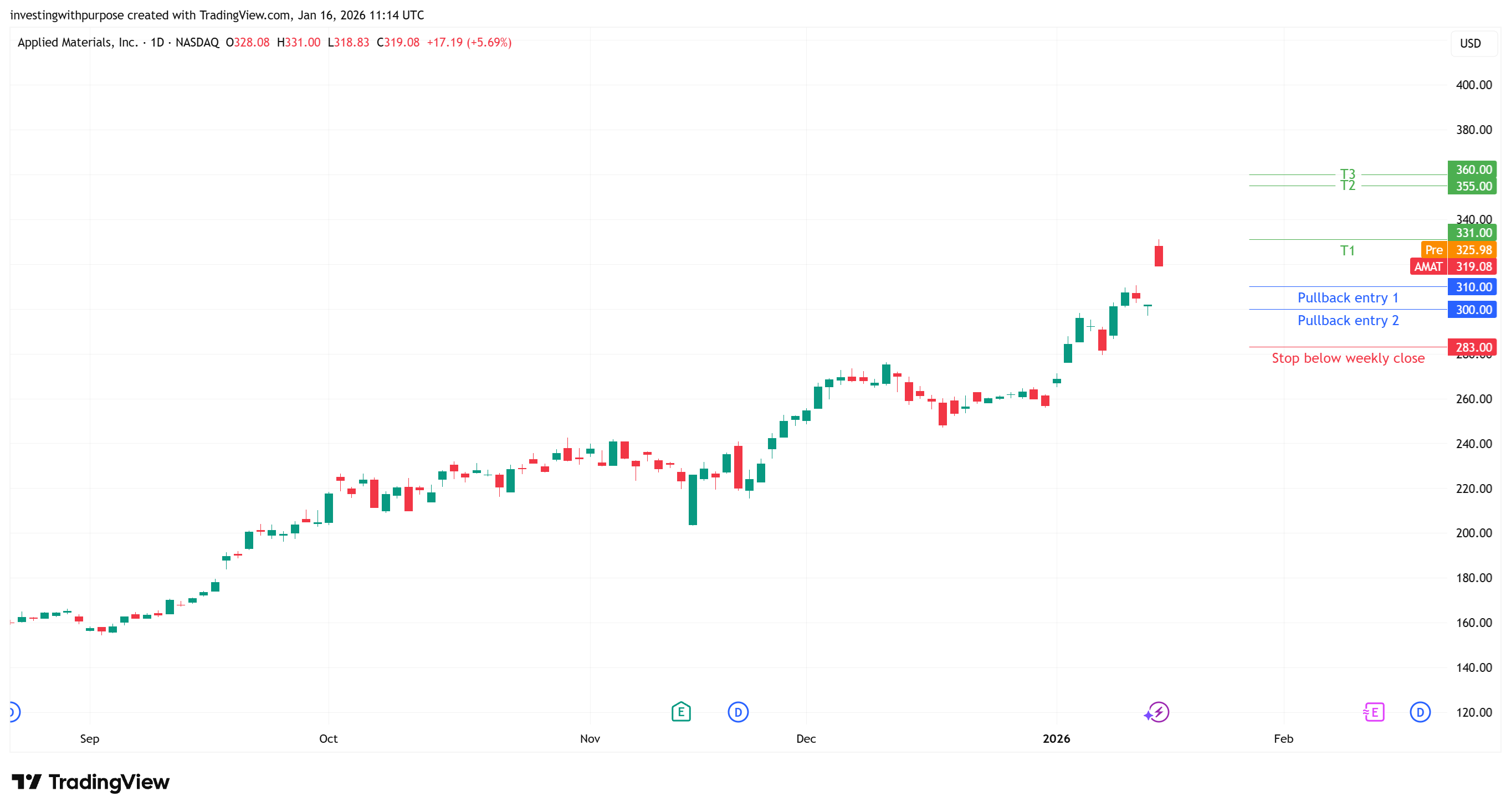
310–300: first meaningful trend reconnection (former resistance + rising averages)
Sub-300: deeper mean reversion where positioning resets more fully
High 280s / low 270s: only relevant if the market demands a broader digestion phase
As long as AMAT holds above major structural support, this is a consolidation.
Updated trade plan for AMAT
For investors already holding:
Shift mindset from accumulation to risk management
Use the 300–305 area as a key reference zone; sustained weakness below it signals the digestion is deepening
Partial de-risking into strength is rational after a vertical repricing
Re-adds only make sense on pullbacks toward structure, not at highs
For investors without a position:
Avoid chasing post-breakout extensions
Favor patience and defined pullback zones
Best entries come when price reconnects with trend support, not when momentum is peaking
High-quality entries live lower, in the 310–300 range first, then sub-300 if the reset deepens.
After a vertical repricing, price discipline matters more than conviction.
Invalidation / risk line
Structural stop concept: weekly close below ~283, with the deeper line at ~252.
Upside targets (updated context)
Near-term resistance: 331
If price regains and holds above that region, the next upside magnet remains the longer-cycle extension band of 355–360.

Lam Research: Torque delivered, volatility remains the price
In December, LRCX 0.00%↑ was too hot to chase but there remained a potential for a breakout entry, which is exactly what happened.
Lam was around $159 and a correction was expected. Instead, it broke out passed all the price targets and exploded to ~$220.
December framework (recap):
Expect a deeper corrective phase
Favor accumulation much lower
Treat Lam as a high-torque, high-discipline name
What happened:
The corrective thesis was invalidated
LRCX 0.00%↑ ripped into the ~229 extension zone
The cycle was repriced aggressively
What’s different from AMAT:
Lam’s power cuts both ways.
Even now, after the breakout, LRCX remains the most volatile and most cycle-sensitive name in the group. That hasn’t changed, and it’s why entries still matter more here than anywhere else.
Where LRCX stands now
Lam remains in a strong trend, but it is transitioning from impulse to consolidation.
On the daily chart:
Price has pulled back modestly from the highs, not collapsed
Moving averages are rising and positively stacked
Momentum has cooled into neutral territory, consistent with digestion
This is important. Lam is pausing above support, which is how leaders behave when buyers remain engaged.
However, Lam’s structure is still far more sensitive than AMAT’s:
When Lam moves, it moves fast
When it corrects, it can overshoot to the downside just as aggressively
That asymmetry is the price of torque.
Updated trade plan for LRCX
For investors already holding:
This is a management phase, not an add-at-will phase
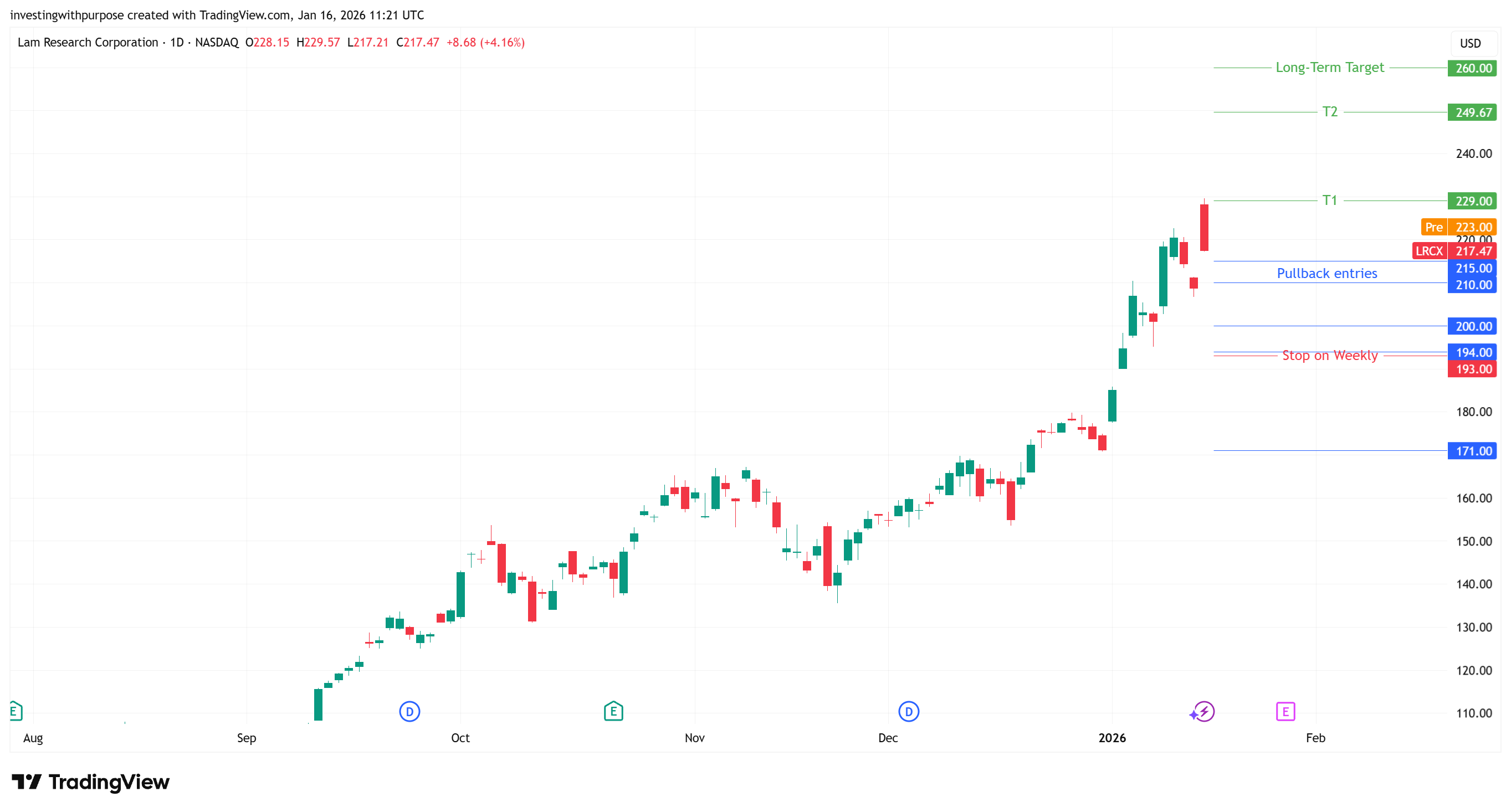
Respect the low-210s area as near-term structural support
Strength back toward the highs is where discipline matters most, not conviction
Any meaningful loss of trend support would argue for de-risking rather than hope
For investors without a position:
Patience remains a position
The highest-quality risk-reward still sits lower, not at current levels
Pullbacks toward the 200 area offer far better compensation for Lam’s cyclicality
Deeper resets only become relevant if the broader market demands it
Lam rewards investors who let the market come to them.
It punishes those who confuse excitement with opportunity.
Pullback buy zones
Zone A: 215–210
First buyable dip at rising EMA support and near-term trend defense.Zone B: 200–194
Higher-quality risk-reward at the next major support shelf where institutions typically step in.Zone C: 194–171
Full cycle reset zone aligned with the 0.382–0.618 Fibonacci retracement. If reached, Lam shifts from “extended” to “priced for risk.”
Risk management
Tactical invalidation: daily loss of ~209 for shallow dip buyers
Structural invalidation: weekly loss of ~193 for longer-term entries
Upside targets
Primary resistance: ~229 (recent high / extension zone)
Above 229: path opens toward the 250 area, but only after a clean reclaim and hold.
Lam rewards patience more than excitement.
That was true before the rally, and it’s still true now.
Closing Thoughts
Nothing in this update changes the hierarchy.
ASML is still the structural choke point.
AMAT is still the most balanced way to own AI capex.
Lam is still the highest torque expression of memory intensity.
What has changed is where discipline matters most.
As cycles mature, returns stop coming from being early to the story and start coming from being selective with price. That’s when trade plans matter more than conviction, and patience becomes an active position rather than a passive one.
The edge here is not predicting demand curves or outsmarting hyperscalers.
It’s knowing where you’re wrong, where you add, and where risk compresses, before the market forces the lesson.
This content is for educational purposes only and is not investment advice.
More from IWP:
Big Banks Beat Earnings (and Hid the Cracks in Plain Sight)

The first wave of U.S. bank earnings delivered a familiar message: EPS beats driven by cost control and trading strength, but revenue trends are increasingly uneven.
How Can Investors Approach Metals Without Getting Burned

Markets do not reward activity. They reward alignment.
Inside Venezuela’s Oil Revival: Which U.S. Companies Stand to Benefit, and When

Venezuela does not need a discovery.