


In Part 1, published April 4, we covered F5’s fundamentals, AI positioning, the BIG-IP vulnerability, and a complete trade plan.
Every single target in that plan has now been hit.
This is the follow-up.
Our paid subscribers will know that the April 4 trade plan called for a pullback entry in the $287–291 zone.
Price touched it on April 10, held, and never looked back.
T1 ($309–312) and T2 ($316), were all hit in sequence. Then on April 28, F5 reported Q2 earnings and the stock blast past T3 to $333–334 before settling around $320, where it’s at today.
So the question is not whether the trade worked. It did.
The question is where do we go from here? Well, here is where things get interesting for FFIV 0.00%↑ .

Key Takeaways
Q2 FY2026 revenue of $812M, up 11% year over year and ahead of the $770–790M guidance midpoint
Seven consecutive quarters of double-digit product revenue growth. Product up 22%, systems up 26%, software up 17%
Non-GAAP EPS of $3.90, up 14% year over year and above the $3.34–3.46 guidance range
Subscriptions now represent 90% of total software revenue, up from 86% last quarter
Non-GAAP gross margin 83.7%, non-GAAP operating margin 33.8%
Record quarterly free cash flow of $348M; cash and investments back up to $1.46B
Full-year FY26 guidance raised again. Revenue growth now 7–8% (from 5–6%), non-GAAP EPS $16.25–$16.55 (from $15.65–$16.05)
BIG-IP cyber overhang is fading. Q2 incident costs dropped to $6M from $17.5M in Q1; demand disruption remains minimal
EMEA grew 22% Y/Y, APAC grew 19%. International acceleration is an underappreciated part of this story
What F5 Does, and Why It Still Matters
FFIV 0.00%↑ sits in the application delivery and security layer. The control plane that manages traffic, secures APIs, optimizes performance, and keeps applications fast and available.
Enterprise workloads are no longer centralized. They are fragmented by design. AI is adding another layer of complexity: more data movement, higher throughput requirements, new categories of runtime security exposure. F5’s platform was built exactly for this environment.
The Under-the-Radar Infrastructure Stock That's Starting to Turn Heads

Most investors hunting AI-driven returns typically look at semiconductors, hyperscalers, and high-multiple software names.
The same three structural demand drivers are now backed by another quarter of concrete customer proof:
Hybrid multicloud adoption: A Fortune 100 energy company was displaced from a long-standing incumbent. A large healthcare services organization refreshed hundreds of legacy systems and expanded to support an AI-driven consumer engagement platform. European regulatory pressure (NIS2, GDPR, DORA) is directly accelerating pipeline in EMEA.
AI inference inflection: A global payments company displaced both an in-house solution and a competitor to put F5 at the center of its AI data delivery infrastructure. A major manufacturer deployed BIG-IP as the production traffic layer across a GPU server environment for a digital twin of their manufacturing operations. 78% of enterprises now run inference themselves, using more than 7 models on average.
Threat landscape expansion: A software and managed service provider deployed F5 as a single security and policy layer across a hybrid multicloud estate, supporting strict healthcare privacy and audit requirements. Attacks are increasingly AI- and agentic-powered. Higher volumes, greater variation, and the era of checkbox security is over.
New product launches this quarter: AI-powered Distributed Cloud WAF, Agentic BOT Defense, F5 AI Remediate, and F5 Insights for ADSP. The product innovation cycle is healthy and accelerating.
Fundamental Analysis
F5 has now beaten EPS expectations for over 20 consecutive quarters. The business is not just growing, it is compounding heavily.
Revenue and Earnings
Q2 FY26 revenue: $812M, up 11% Y/Y
Product revenue: $411M, up 22% Y/Y
Systems revenue: up 26% Y/Y
Software revenue: up 17% Y/Y, with 90% from subscriptions
Seven consecutive quarters of double-digit product revenue growth
Non-GAAP EPS Q2 FY26: $3.90, up 14% Y/Y
H1 FY26 non-GAAP EPS: $8.35, on pace to comfortably exceed full-year guidance midpoint
Margins and Profitability
Non-GAAP gross margin: 83.7%. Exceptional for an infrastructure business and essentially stable
Non-GAAP operating margin: 33.8%, up ~190bps Y/Y
GAAP operating margin: 22.1%. Weighed down by stock-based compensation ($68M), amortization ($11M), and cyber incident costs ($6M, down from $17.5M in Q1)
The gap between GAAP and non-GAAP EPS ($2.58 vs $3.90) is real dilution that should not be ignored
Cash Flow and Capital Returns
Q2 operating cash flow: $366M. Strongest quarterly print in recent history
Q2 free cash flow: $348M
FY26 YTD free cash flow: $497M, with 80% directed to share repurchases
Q2 buybacks: $100M; $400M total YTD
Commitment: at least 50% of annual FCF to buybacks
$522M remaining on authorized repurchase program as of March 31, 2026
Balance Sheet
Cash and investments: $1.46B (up from $1.22B at end of Q1, despite ongoing buybacks)
Total debt: minimal, primarily capital lease obligations
Deferred revenue: $2.12B, up 10% Y/Y, strong forward revenue visibility
Recurring revenue: $564M, representing 70% of Q2 total revenue
Guidance
Q3 FY26 outlook: revenue $820–840M, non-GAAP EPS $3.91–$4.03
FY26 revenue growth: raised to 7–8% (from 5–6% after Q1, from 0–4% originally)
FY26 non-GAAP EPS: raised to $16.25–$16.55 (from $15.65–$16.05 after Q1)
FY26 non-GAAP operating margin: 34–35%
Valuation
Compared to infrastructure and security peers, FFIV 0.00%↑ screens as the most fairly priced quality name in the group. Not cheap, but not stretched:
Forward non-GAAP P/E: ~17.8x below Fortinet (28.6x), Cisco (21.4x), Amazon (29.9x), and A10 Networks (25.3x)
EV/EBITDA: ~17.3x at or below all comparable names shown
Price/Book: 4.6x reasonable for a business with $1.46B in cash and growing equity
Price/LTM Sales: 5.2x in line with the quality infrastructure peer group
Total Debt/Total Capital: 1.3% effectively zero financial leverage
These are fair multiples for a business with 83%+ gross margins, 70% recurring revenue, and accelerating free cash flow. Upside from here depends on continued execution, not multiple expansion.
The Cyber Overhang: An Update
Part 1 gave this significant attention. It deserves an honest update.
The Q2 results effectively confirmed that demand disruption was minimal and contained. Cyber incident costs fell from $17.5M in Q1 to $6M in Q2. Management described customer feedback on the response as positive, and CISO engagement deepened in several accounts rather than weakening.
This is not fully resolved. The reputational exposure in procurement conversations and renewal cycles takes longer to fully clear. But it is no longer the dominant investment narrative. Two more clean quarters of unaffected demand would effectively close this chapter.
Technical Analysis
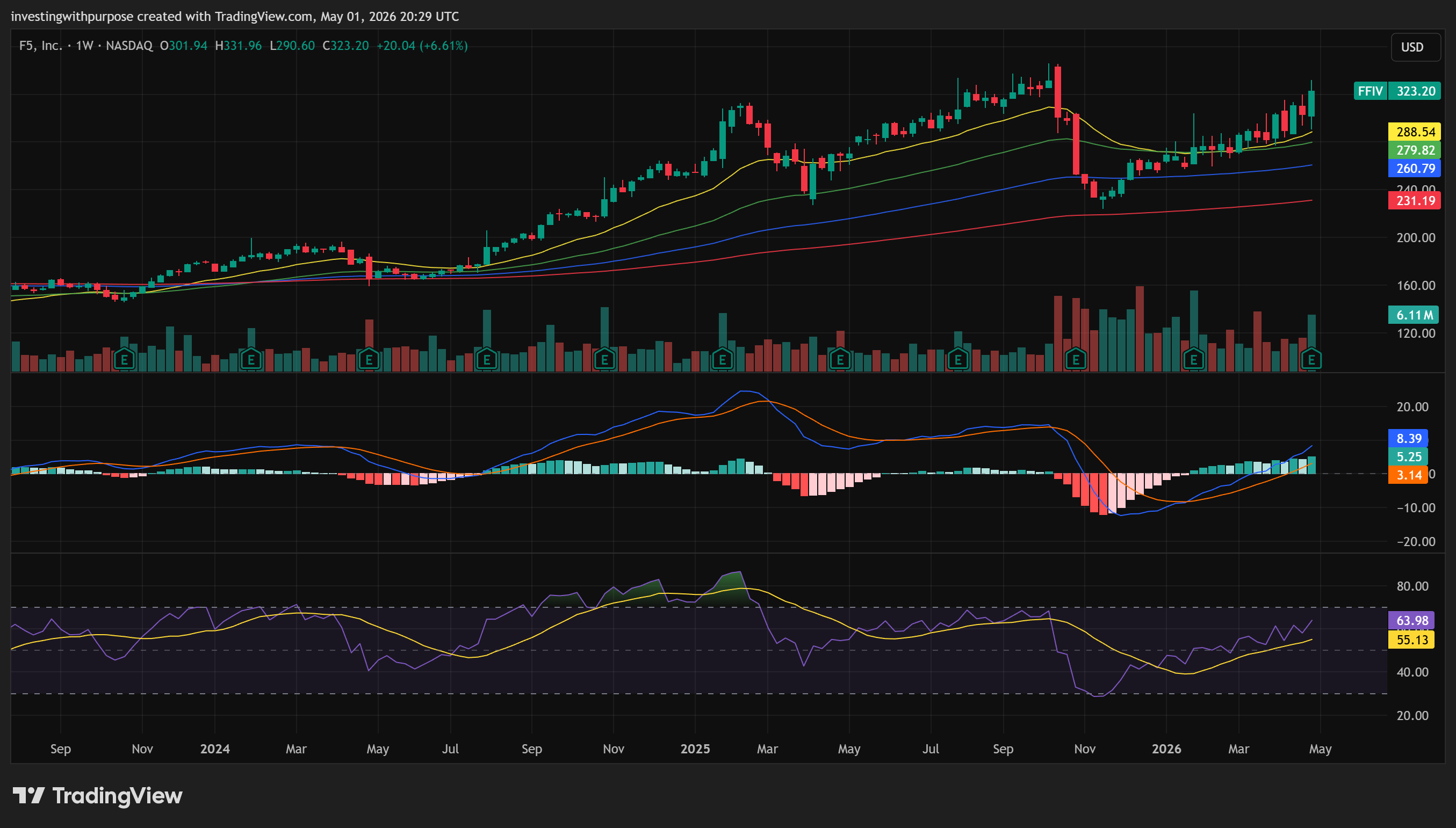
Weekly chart:
The moving average stack across all major timeframes is fully bullish and fanning out. Trend structure is intact
Momentum indicators are turning up from relatively low levels, not from an extended peak
RSI in the mid-60s. Healthy, not overheated, room to continue
That said, the longer-term chart carries a structural warning that cannot be dismissed: the current advance is pressing into a significant supply zone near $330–332 that has been visible as a key target level for months. If price stalls and fails to break through this area with conviction, the setup for a more meaningful multi-month pullback becomes the dominant risk scenario. This is not the base case, but it must remain in the mental model for anyone holding a full position
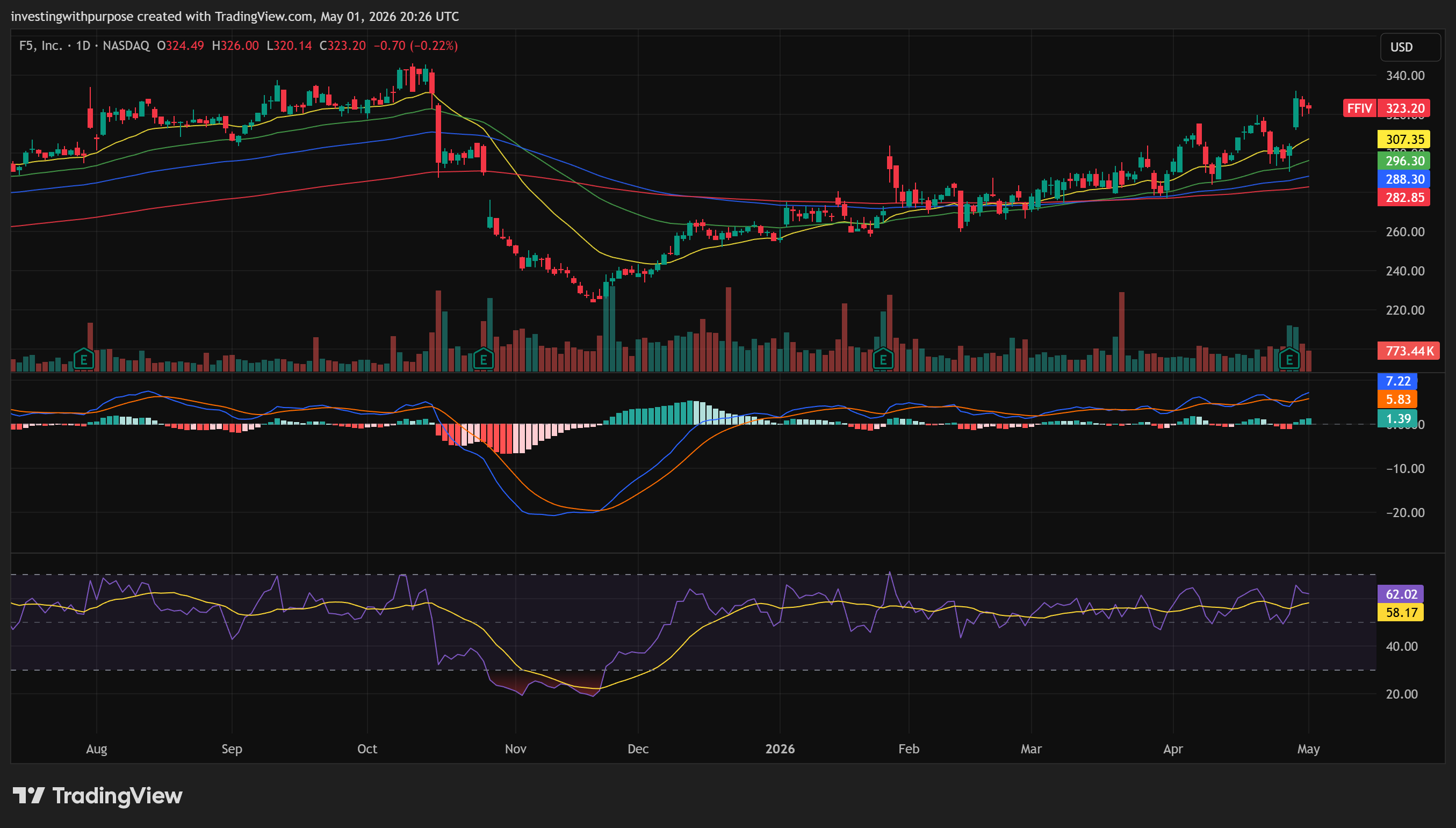
Daily chart:
Price gapped from ~$293–295 to a high of ~$333–334 before settling around $322–323
All moving averages stacked bullishly beneath price: 20-day ~$307, 50-day ~$296, 100-day ~$288, 200-day ~$283
Price has completed what looks like a full advance from the late 2025 lows. A short-term corrective pullback toward $302–313 would be entirely normal from this position before any continuation higher
Short-term chart:
The earnings event is clearly visible: price compressed into $292–299 pre-announcement, exploded to $330+, now digesting in the $320–325 zone
Near-term trend indicators are pointing steeply upward, with short-term moving averages at $321 and $315 acting as immediate support
RSI has cooled from the post-earnings spike and is normalizing in the low 60s, going for a healthy reset
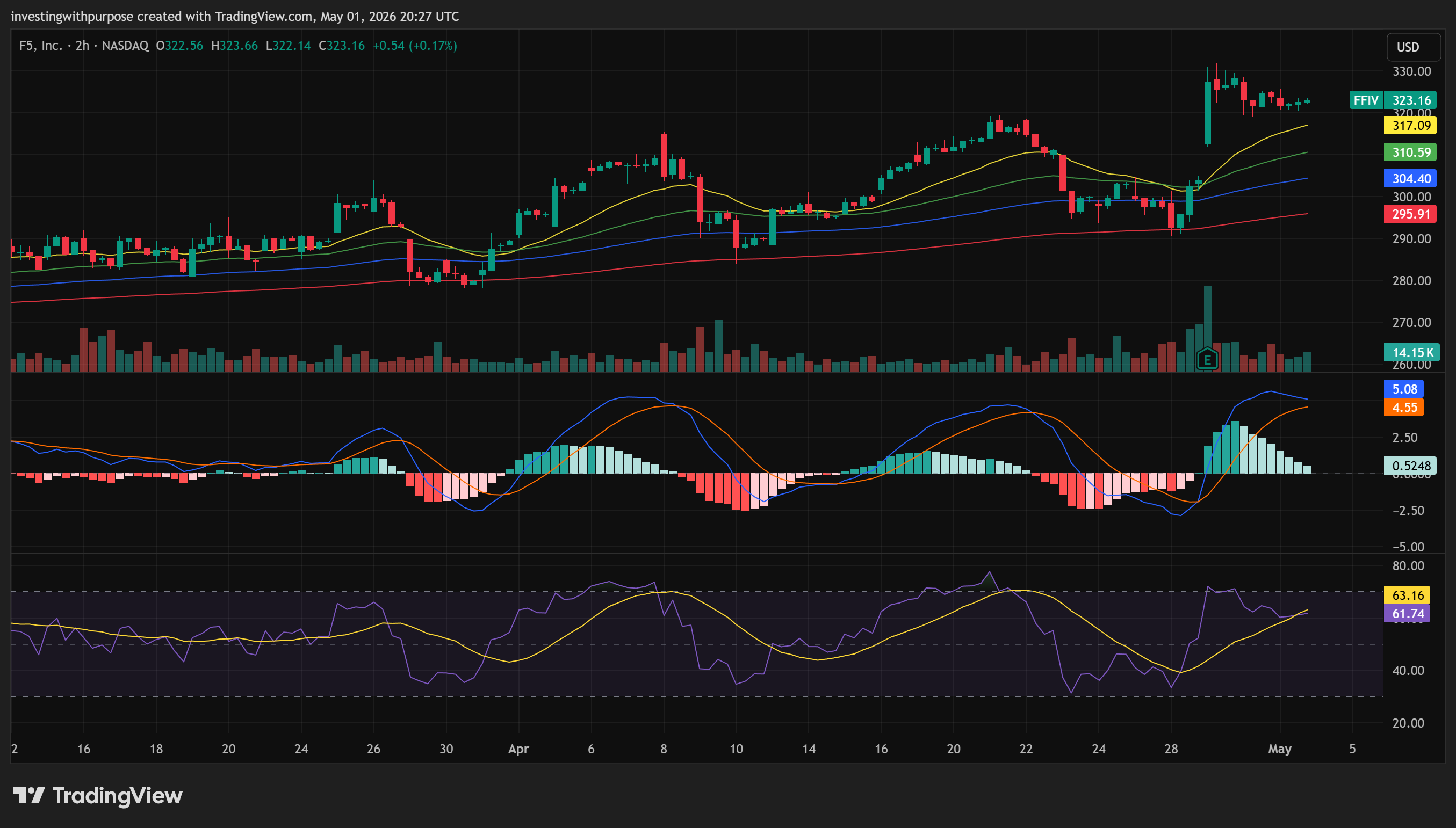
Across all timeframes: moving average stacks are aligned bullishly and momentum is digesting post-earnings in a healthy, orderly fashion.
Key Levels
Support:
$319–322: Short-term moving average support and current consolidation base. First line of defense on any dip
$305–313: Primary pullback target zone. In range of the rising 20-day moving average, and the normal corrective range from the current peak. The quality entry zone for new positions
$295–302: Deeper support shelf. Pre-earnings consolidation base and rising 50-day moving average. Better risk-reward, but requires more patience
$282–285: Long-term structural support, still the line in the sand for the larger thesis
Resistance:
$326–332: Immediate overhead zone and earnings day high area. The current test
$340–341: Next measured extension target if $332 breaks cleanly
$375: Longer-term stretch target. Only relevant in a strong continuation scenario with momentum confirmation
Critical structural level: $282–285. A decisive close below this zone would shift the dominant interpretation from bullish continuation to a more serious corrective reset. Below it, reassess the thesis entirely.
Trade Plans
If You’re Already Holding
Position bias: Long. Protect gains, let the structure work, but manage the position actively. Price is pressing into known overhead resistance.
Stop / protection:
Trailing stop: daily close below $309–312
Locking in gains above the T3 level from the original plan. A close below this level signals the post-earnings momentum has broken down and the corrective move is extending beyond normal digestion. Exit remaining position.
Management guidance:
Consider trimming 25–33% in the $325–332 zone if not already done. Price is pressing directly into a well-defined resistance area and locking in partial gains into strength is disciplined risk management at any conviction level
Do not add to the position at current prices. Adding above $320 after a gap of this magnitude skews risk-reward unfavorably
Targets (for remaining position):
T1: $331–334 → key overhead resistance and earnings day high. Logical trim zone
T2: $341 → next measured extension target above the breakout
T3 (stretch): $375+ → only valid with momentum confirmation and a clean hold above $341
If You’re Considering a New Position
Position bias: Selectively long, tactically patient. The trend is intact and the fundamentals improved materially. Entry price matters.
Time horizon: 1–3 months (swing), with Q3 earnings as the next major catalyst.
Entry zones:
Primary entry: $305–313. The ideal reset zone. Sitting at the intersection of the rising 20-day and 50-day moving averages. Wait for a confirmed stabilization candle before entering.
Secondary entry: $295–302. If the pullback extends further, this zone offers the pre-earnings consolidation base and rising 100-day moving average as meaningful support. Better risk-reward, but requires patience.
Breakout entry: above $332–334 on a daily close with volume. Valid if price consolidates tightly and clears the earnings day high. Lower-probability near-term but not to be ignored if the structure sets up cleanly.
Stops / invalidation:
Stop for primary and secondary entries: below $296. A daily close below the 100-day moving average and the pre-earnings base removes the structural argument. Exit without hesitation.
Stop for breakout entry: below $319–322. A failed breakout that pulls back below the current consolidation base invalidates the breakout setup. Tight stop, disciplined exit.
Structural stop: below $282–285. Applies across all entry scenarios. Below this level the larger corrective picture becomes dominant. Step aside entirely.
Targets:
T1: $331–334 → key overhead resistance and earnings day high.
T2: $341 → next measured extension target above the breakout
T3 (stretch): $375+ → only valid with momentum confirmation and a clean hold above $341
The Bottom Line
F5 delivered one of the cleanest fundamental quarters in its recent history. Revenue growth accelerating, margins holding, free cash flow at record levels, guidance raised for the second consecutive quarter, and AI wins that are concrete rather than theoretical. The business is executing.
The chart reflects it. The April trade played out exactly as mapped. All three targets hit. The earnings gap added another leg. Anyone who followed the plan and managed the position has little to complain about.
What comes next is a different kind of discipline. Price is sitting at well-defined resistance after a sharp move. The risk-reward of chasing is poor. The opportunity for new positions lies in the pullback. Defined, patient, and confirmed. For those already holding, the job is to protect what the trade earned while giving the remaining position room to work.
The structural risk on the longer-term chart. A potential more significant decline if this resistance zone rejects price has not disappeared. It remains the scenario that demands respect and separates disciplined positioning from complacency. Keep it in the plan.
F5 is a quality business in the right place at the right time. The next quarter will tell us whether the momentum continues to build or whether the chart needs time to consolidate before the next leg. Either way, the framework is clear.
Stay disciplined. Manage the levels. Let the trade come to you.
This content is for informational and educational purposes only and reflects our views at the time of writing. It is not investment advice or a recommendation to buy or sell any security. Markets involve risk, prices can move against you, and outcomes are never guaranteed. Always do your own research and consider your risk tolerance before making investment decisions.