


A couple of weeks ago we wrote that the AI buildout has a credit problem. The examples were the obvious ones: CRWV 0.00%↑ borrowing at 15.78%, smaller companies paying for GPUs with money collected from customers in advance, thin balance sheets carrying very large building programs.
META 0.00%↑ is the other end of that spectrum.
It has an 81% gross margin, $241.6B of trailing revenue, and an advertising business that keeps on printing money.
But on 21 October, it reported a quarter in which it spent more cash than it generated.
Key Takeaways
Operating cash flow was $32.79B. Capital expenditure was $33.94B. Add $964M of finance lease payments and free cash flow came to negative $2.12B, vs +$10.6B a year earlier.
Meta repurchased $26.25B of stock in the first 9 months of 2025. In the first 9 months of 2026 it repurchased nothing at all.
Long-term debt went from $28.8B to $80.9B in the last 4 quarters, after sitting flat for over a year before that.
A $97.5B equity package followed, split between a $25B forward sale, a $12.5B mandatory convertible and a $60B at-the-market program in a new non-voting Class C share that starts trading in January.
Nvidia, AMD, and Broadcom pledged up to $5B into the offering, meaning Meta’s chip suppliers are buying equity in their own customer.
Q3 Results Snapshot
Revenue hit $64.60B, up 26%, and above expectations.
Advertising was responsible for $63.06B of that.
Income from operations was $12.99B, down 37%, and the operating margin halved from 40% to 20%.
Most of that gap is from Meta’s August settlement with 52 state attorneys general over teen mental health, for payments of up to approximately $18.59B, and took a $9.89B charge in the quarter.
Excluding that, operating income was $22.88B, up 11% on last year.
Even adjusted, operating profit grew at less than half revenue growth. It’s clear to see that AI spending is growing way faster than the business is.
Where the Cash Went
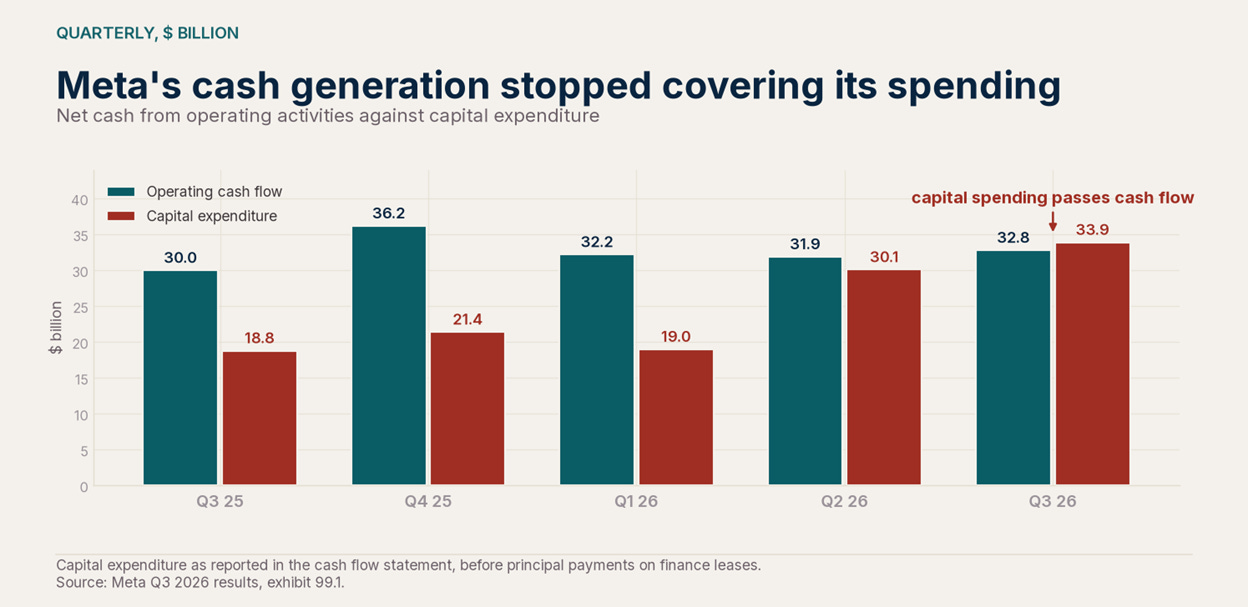
Operating cash flow barely moved in 5 quarters, hovering between $30B and $36B. In the meantime, capital spending increased from $18.8B to $33.9B, and in the last quarter it exceeded incoming cash for the first time in a while. That’s not a coincidence.
Meta’s own guidance is for $135B to $145B of capital expenditure this year, including finance lease payments. For context, the whole company generated $133.1B of operating cash flow over the trailing 12 months. The buildout is now roughly the size of everything the business produces.
On Meta’s own definition, which nets off finance lease payments, quarterly free cash flow went from $13.2B in March to $784M in June to -$2.12B in September. Across the first 9 months it fell from $29.5B to $11.0B.
The Halted Buyback
From Meta’s Q3 cash flow statement, you can clearly see:
Repurchases of Class A common stock, 9 months to September 2025: $26,248M.
Repurchases of Class A common stock, 9 months to September 2026: nil.
Buybacks weren’t reduced, they stopped. Meta has bought back no stock at all this year, after averaging roughly $9B a quarter over the same 9 months in 2025. It still pays a dividend, $4.06B over the 9 months, but the buyback that absorbed most of its spare cash for years is simply gone.
That sure looks like a clear statement of priorities.
Balance Sheet Dynamics
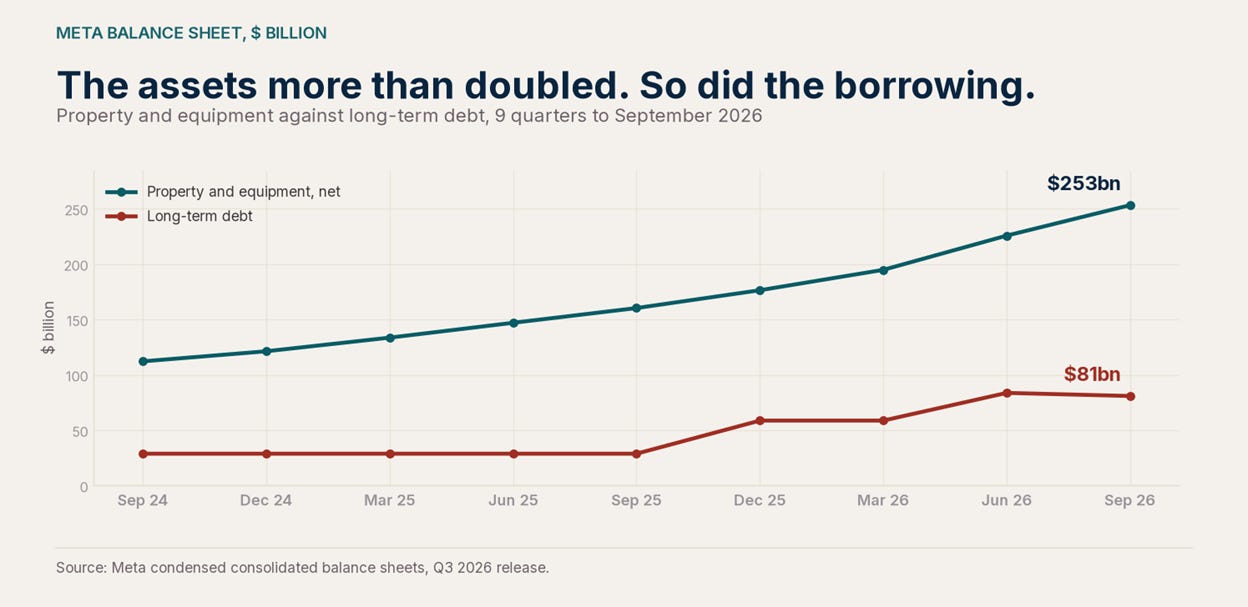
PPE went from $112.2B to $253.2B in 2 years. That’s data centers.
The debt line is also interesting, fixed at $28.8B for 5 consecutive quarters. Then, in the December 2025 quarter it doubled, and by June 2026 it had tripled, reaching $83.7B before settling at $80.9B.
Meta raised $24.91B of long-term debt in the first 9 months of this year alone. Cash fell from $43.9B in September 2024 to $11.2B now, while marketable securities went the other way, up to $71.2B, so the total it can get at quickly is roughly unchanged at $82.4B.
Total liabilities have gone from $91.9B to $206.5B.
New Equity Funding Package
This is what makes this funding different from other companies’ AI capex expenditures.
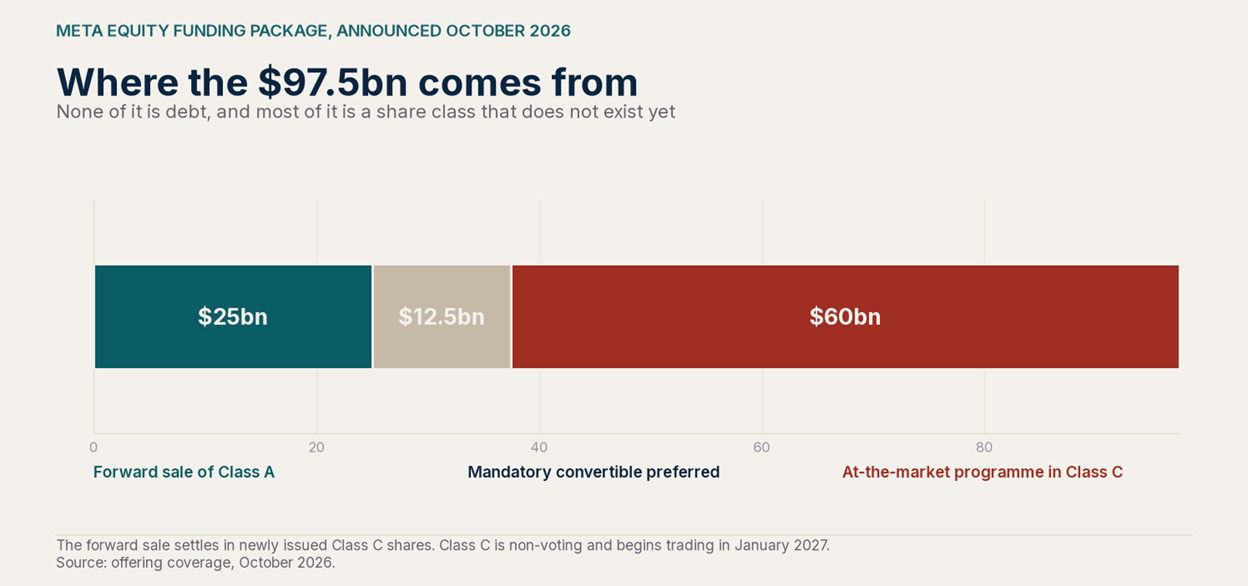
Meta announced an equity funding package of up to $97.5B, in 3 pieces.
The first tranche is a $25B forward sale. Morgan Stanley and Goldman Sachs sold 40 million borrowed Class A shares at $625 each, and Meta will deliver newly issued Class C shares at settlement. The company has effectively sold stock that does not yet exist.
The second is $12.5B of mandatory convertible preferred, carrying a 6.5% dividend and a 17.5% conversion premium, converting into Class C.
The third (and largest) is a planned $60B at-the-market program in Class C shares, beginning when they start trading.
Demand was reportedly strong. One report put orders for the first piece at $125B, about 5 times what was offered.
Why the Shares Have No Votes
The Class C stock is new, non-voting, and takes effect in January 2027. Existing holders receive it one-for-one as a dividend in mid-January, with trading starting later that month.
Meta’s board approved it on the unanimous recommendation of a special committee of independent directors set up specifically to look at the capital structure. The stated purpose is capital raising, employee compensation, acquisitions and general corporate purposes.
But the real reason is simpler. Class A carries 1 vote, Class B carries 10, and Mark Zuckerberg’s control rests on the Class B.
Raising $97.5B of ordinary equity would dilute that control considerably, but when you’re raising it through a share class with no votes, that control doesn’t get diluted at all.
It is a sensible structure that lets a founder-controlled company raise serious money without a governance fight. It’s also a company redesigning its share register around 1 person’s control in order to fund a spending program.
The Suppliers Are Buying the Customer
NVDA 0.00%↑, AMD 0.00%↑ and AVGO 0.00%↑ have pledged to invest up to $5B into Meta’s equity offering.
Those 3 companies sell Meta the chips it is raising the money to buy.
There’s nothing illegal or hidden here, and suppliers putting money into a customer’s fundraise is an old practice. $5B out of $97.5B is a tiny fraction, but it’s the same circular money that has made people uneasy about AI deals all year. The difference is that it’s now happening at the top of the market rather than among the small players.
If you were listing the things that would make a sceptic uncomfortable about this cycle, suppliers funding their customer’s purchases of their own products would be high on it.
What Investors Pay
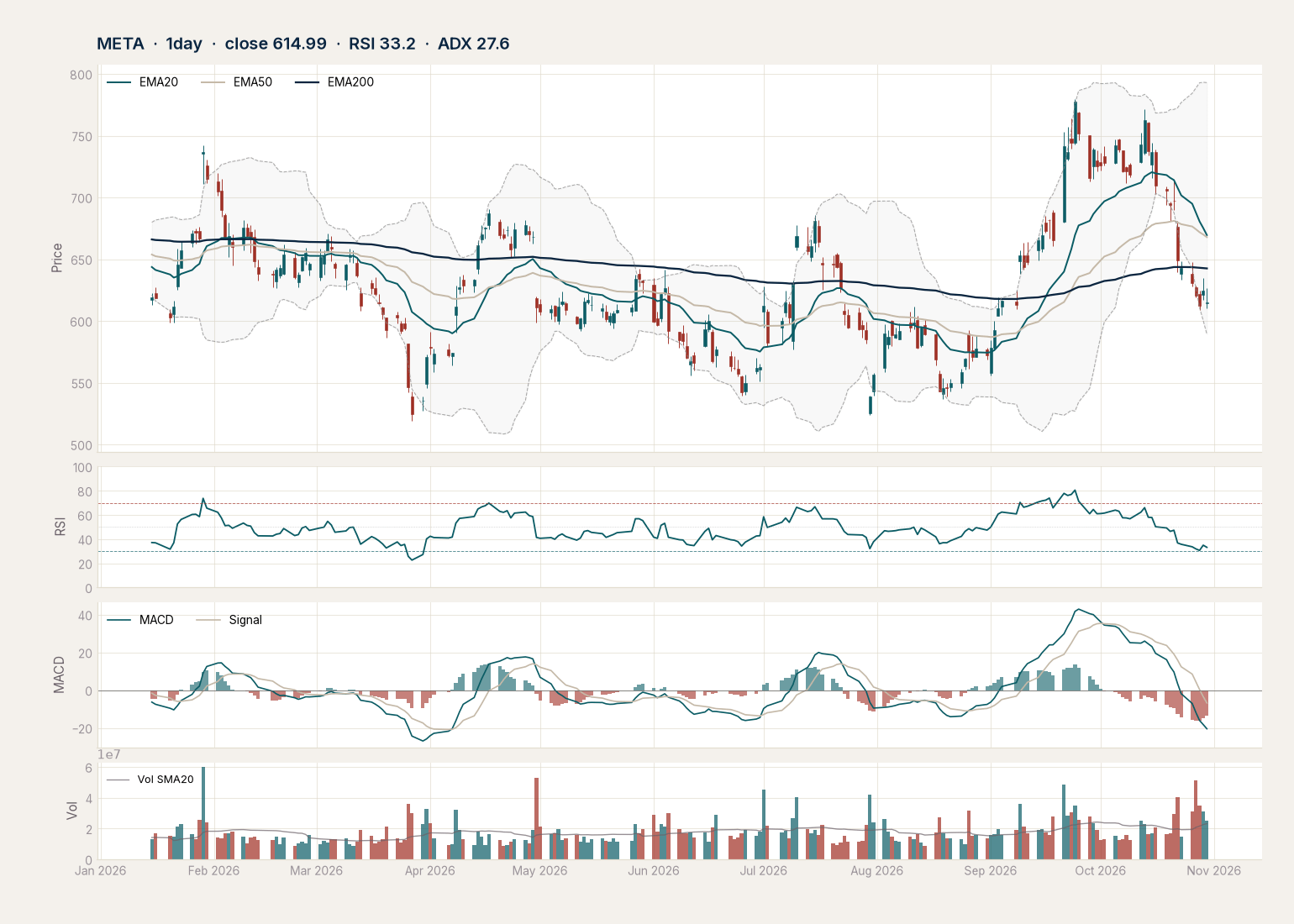
At $614.99 Meta trades at 17.4 times forward earnings and 6.5 times trailing sales, with a trailing free cash flow yield of 1.8%. The stock is 21.1% below its 52-week high and has fallen 3.6% over the past year, against a 10.6% gain for the S&P 500.
That’s not an expensive multiple for this business; it’s roughly in line with Alphabet and well below Microsoft or Amazon.
The peer group explains some of it, though not in the way the headlines suggest. Microsoft generated $60.0B of free cash flow over its last 4 quarters and is not straining at all. Alphabet’s trailing figure is still positive at $19.7B, but its last 2 quarters were negative, at minus $9.1B and minus $5.9B. Oracle has been negative in all 4, totaling -$28.7B, and its stock is down 49.3% over the year.
So this isn’t a sector-wide collapse in cash generation. It’s a rolling one, arriving company by company as each capex program passes its own cash flow. Meta’s quarter was its turn, and the market has started pricing these businesses on that crossover rather than on earnings.
Analysts have not followed. The average target sits at $848, around 38% above the price.
Where This Breaks Down
The case for buying this is a good one, and worth stating properly.
Meta says its AI investments are already delivering incremental advertising revenue through better recommendations and more efficient monetization, and the 26% revenue growth supports that. Reality Labs losses are guided to narrow to around $15B next year from, so some of this spending is a reallocation rather than an addition. Fourth-quarter revenue is guided to $73B to $76B.
The balance sheet is also quite strong. Debt to equity is 0.42, the current ratio is 1.9, and $82.4B of cash and securities sits against it. Meta is rated Aa3 and AA minus. This is not CoreWeave and nobody should pretend otherwise.
And a company with an 81% gross margin spending hard for 2 years and then collecting is a pattern that has worked for this management team before.
The problem with it is that the spending keeps climbing while the returns are still not clear and materialized. Forecasts for 2027 capital spending already run above $225B, which would put the credit rating under pressure.
What to Watch
The quarterly free cash flow line. One negative quarter is an event. 4 in a row would be a business model.
Whether the at-the-market program actually gets used in January. Announcing $60B of capacity and drawing it are different things, and the pace of drawdown will say how much of this was precautionary.
The January results, which should carry a full-year 2027 capex number. Management wouldn’t give one this time.
Bottom Line
Nothing in this quarter suggests Meta’s advertising business is in trouble. Revenue grew 26% and the core engine is working.
What changed is how the company pays for what it’s building. For a decade Meta funded everything out of its own cash flow and handed the surplus back through buybacks. In 2026 it stopped the buybacks, tripled its debt, spent more than it earned, and arranged to sell nearly $100B of equity in a share class designed not to dilute its founder’s control.
That is a company behaving like one that needs capital, which is a genuinely new thing for Meta.
The credit problem we wrote about a couple of weeks ago showed up first in companies with weak balance sheets, because that’s where money trouble always shows up first.
It has now reached the strongest balance sheet in the business. Meta can clearly afford all of this, but the question worth asking is why a company this profitable had to redesign its share register to pay for it.
We don’t predict. We prepare.
All content provided is for informational and educational purposes only and does not constitute investment advice, a recommendation, or an offer to buy or sell any security. The trade plans, levels, and scenarios discussed are illustrative frameworks based on market structure and are not guarantees of performance. Markets involve risk, and losses are possible. Past performance is not indicative of future results. Each reader is responsible for their own investment decisions, position sizing, and risk management.