


Welcome back to the head-to-head we’ve been running on LLY 0.00%↑ and NVO 0.00%↑ for over a year.
Both report tomorrow, Wednesday August 5.
Both sell the same molecule class into the same demand. And for the first time since we started covering them together, they are not telling the same story.

Key Takeaways
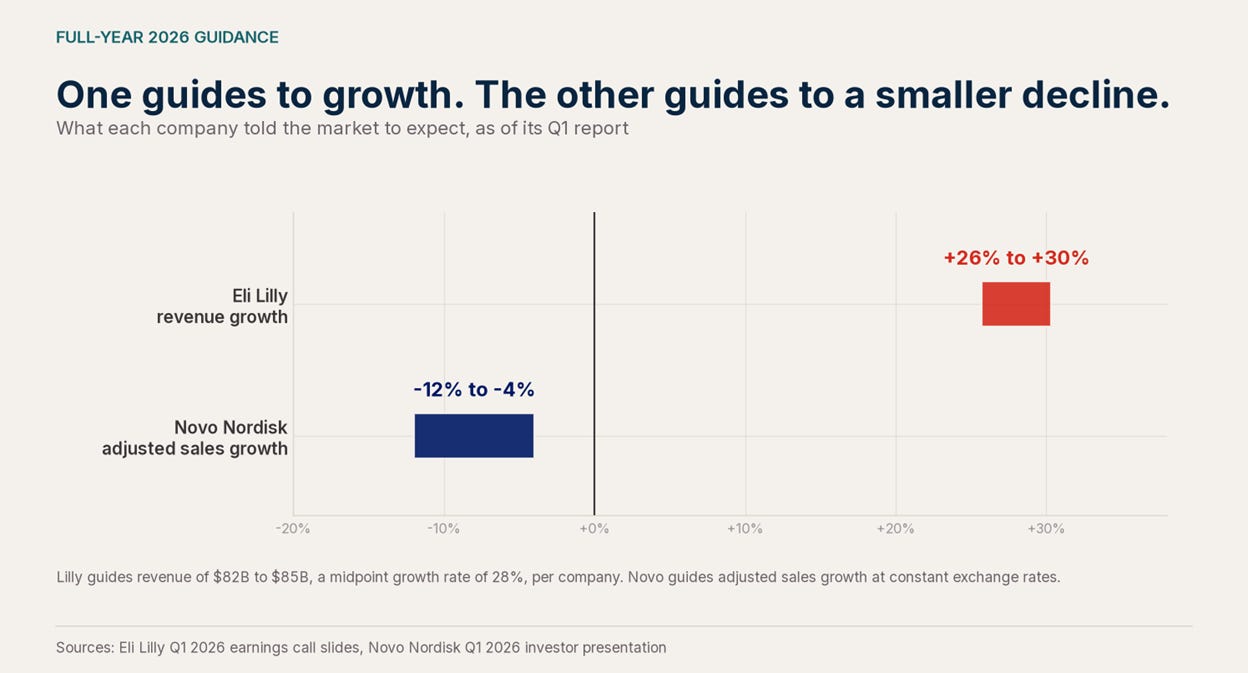
Both companies raised guidance. Only one raised into growth. Lilly went to $82B - $85B of revenue, 28% growth, and lifted EPS guidance to $35.50 - $37.00. Novo’s raise took it from -5%/-13% to -4%/-12% adjusted sales growth.
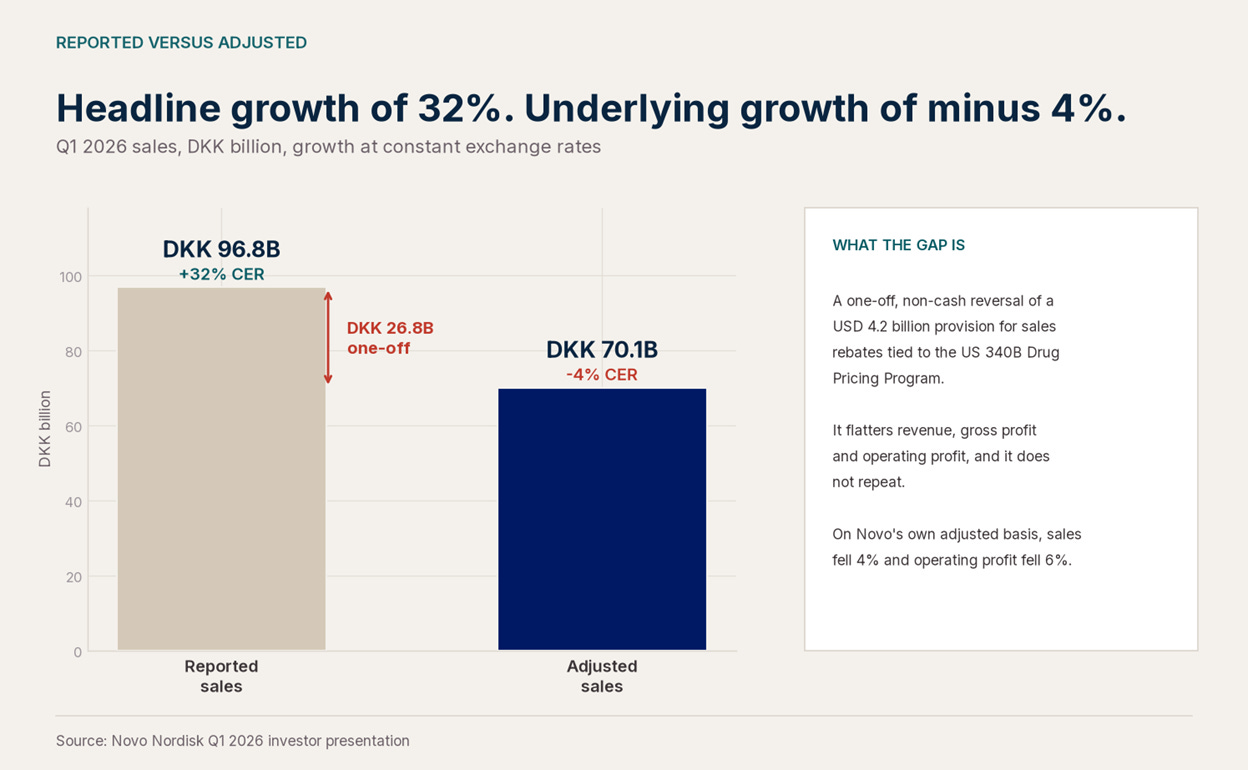
Novo’s headline quarter was not what it looked like. Reported sales of DKK 96.8B, up 32%, include a one-off non-cash reversal of a USD 4.2B rebate provision. Strip it out and sales were DKK 70.1B, down 4%.
Lilly is winning the open market. Its data puts US incretin share at 60.1% against Novo’s 39.4%, in a market growing 30%.
You pay 39.6x for Lilly and 11.1x for Novo. That gap isn’t a mispricing to arbitrage. It’s growth priced against decline, and both can be right.
See the trade plan below for thoughts on how to play this before and after earnings.
What happened since our last article
On May 18, we said LLY 0.00%↑ rewards trend-following and NVO 0.00%↑ rewards patience on entry with discipline on the stop.
Lilly: Our pullback zone was $945 to $975. The lowest print since was $978.87, just above the pullback zone.
Price then hit our $1,025 breakout zone trigger. And from there, it hit our T1 at $1,065 and the T2 at $1,210. If you bought above the pullback zone or bought the breakout, you did well (24% return from pullback to T2 / 18% return from breakout to T2).
Novo: Our buy zone was $42.50 to $43.50 which was hit. Sadly, the price then closed below the $42.50 stop and the trade was over. It bottomed at $41.00, then recovered and hit our T1 on June 25.
See our previous coverage of LLY and NVO here:


Lilly: an oral launch and a raised bar
LLY 0.00%↑ is a trillion dollar business that turned one molecule into a franchise across diabetes, obesity, sleep apnea and heart failure. Trailing revenue is $72.25B.
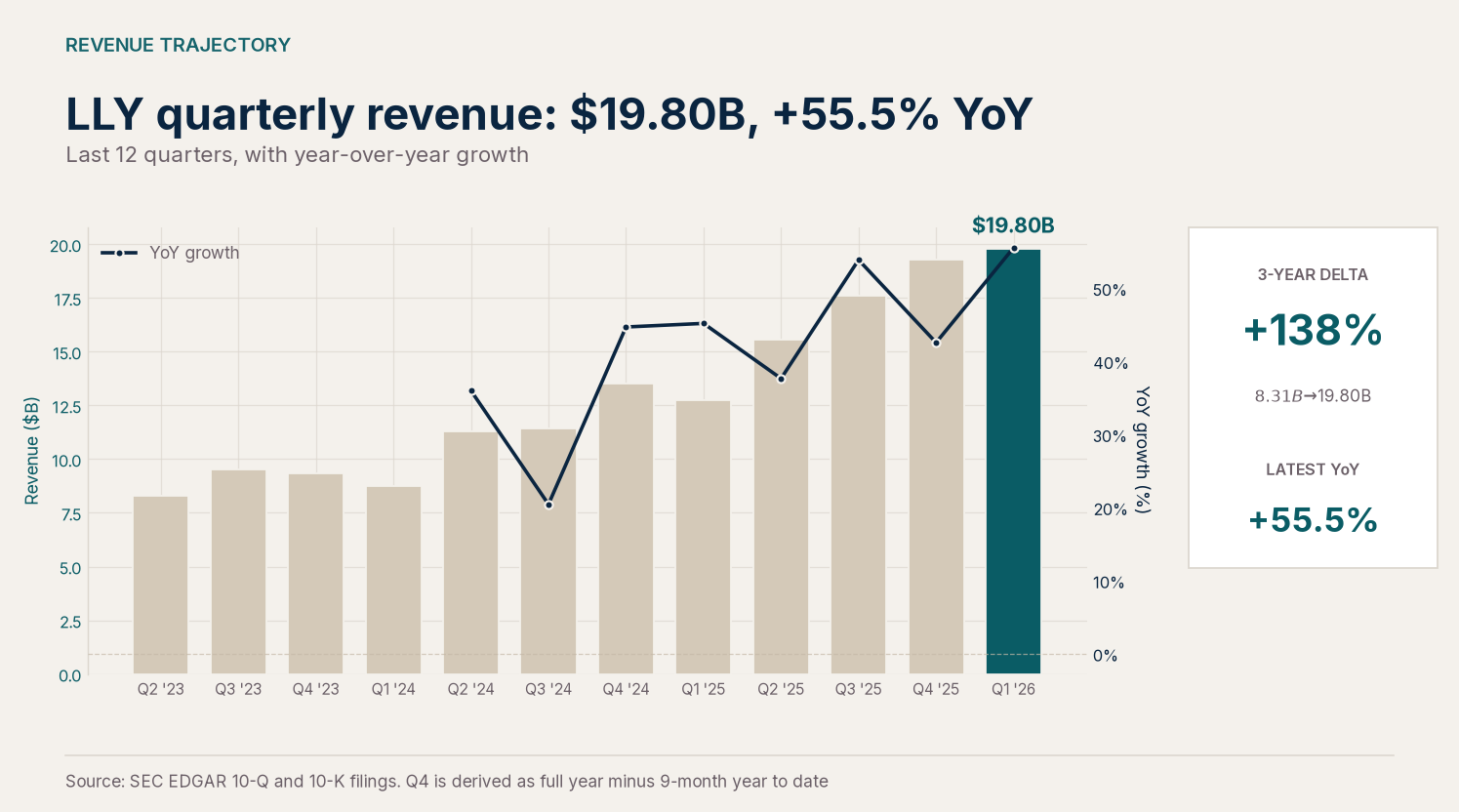
The quarter it reported April 30 reset expectations. Revenue of $19.80B grew 56%, adjusted EPS of $8.55 grew 156%, operating income grew 142%.
The breakdown matters as much as the headline numbers:
Volume added 65%. Price subtracted 13%. Lilly is growing by selling many more units at lower prices.
Zepbound did $4.2B, up 80%. Mounjaro holds 51% of US prescriptions in its category.
Beyond the franchise, Ebglyss grew 141% and Jaypirca 79%.
The US grew 43%. Rest of world grew 178%.
Then there’s Foundayo, the oral. It hit US retail April 9 2026, roughly 35% of launch volume is coming through telehealth, 2 of 3 major PBMs confirmed access by mid-May, Medicare opened July 1, and full consumer promotion only starts this quarter. Wednesday’s earnings will give the first clean look at that ramp.
Management raised revenue guidance to $82B - $85B and EPS guidance to $35.50 - $37.00.
Here’s the detail most previews miss. Consensus for full-year EPS sits at $34.53, below the floor of management’s own raised range. Lilly has beaten 4 quarters running, by 25.9%, 5.2%, 19.2% and 12.5%.
Novo: a price cut, a pill, and an accounting artifact
Novo Nordisk is a $208B Danish company that built this category with semaglutide and is defending a lead it no longer holds in the US. Trailing revenue is DKK 327.8B, ($50.5B).
Its Q1 looked like a blowout and wasn’t.
Reported sales of DKK 96.8B were up 32%. But DKK 26.8B of that, (~USD 4.2B), is a one-off non-cash reversal of a rebate provision. It boosts revenue, gross profit and operating profit, and it does not repeat.
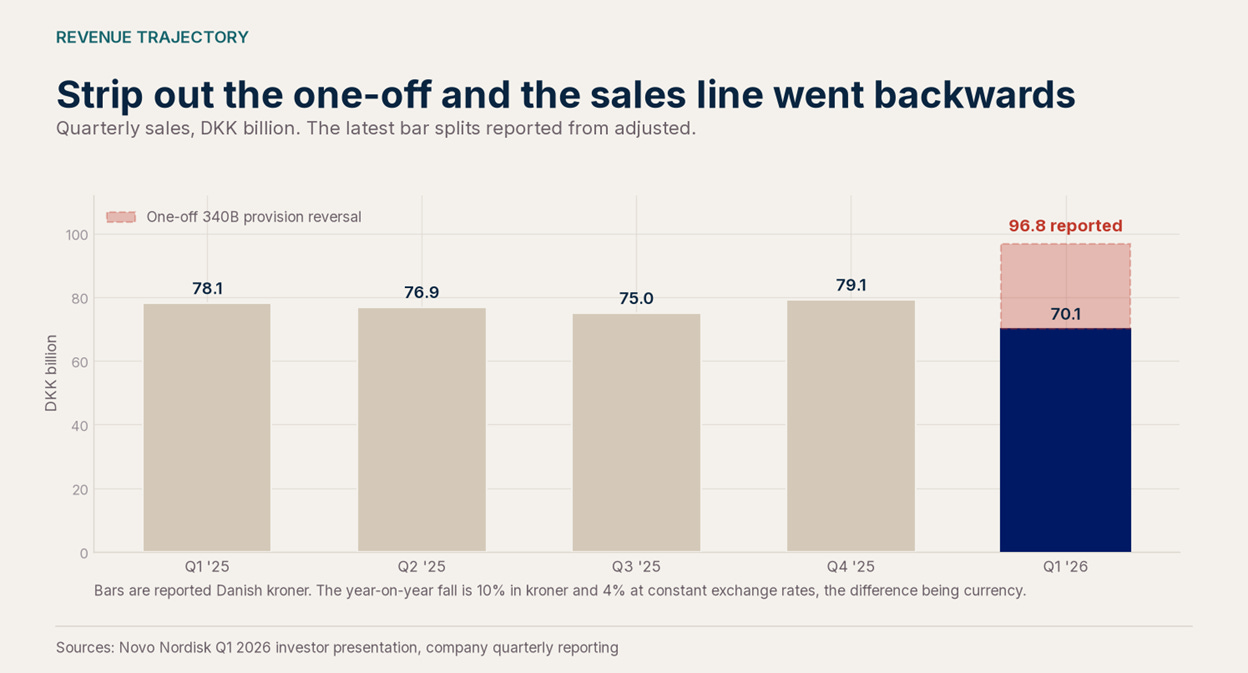
On Novo’s own adjusted basis: sales fell 4%, operating profit fell 6%, and gross margin was 80.6% rather than the reported 85.9%.
The commercial picture underneath is mixed rather than broken. The Wegovy pill has reached more than 1 million people in the US and runs about 207,000 weekly prescriptions. Novo still holds roughly 55% of weekly injectable GLP-1 volume globally, and Wegovy is in more than 55 countries.
But pricing is what shapes the next 2 years. From January 1, 2027, Novo cuts US list prices to a flat $675 per month for Wegovy, Ozempic and Rybelsus, roughly 50% off Wegovy and 35% off Ozempic. That’s why a company with a growing pill franchise guides its sales line lower.
CagriSema is submitted in the US with a decision due in the fourth quarter. It’s the 2027 swing factor, and it already read as inferior to Zepbound in Novo’s own comparison.
Fundamentals
On the income statement they’re very similar. Lilly runs an 82.8% gross margin, 47.3% operating margin and 35.0% net margin. Novo runs 81.9%, 45.3% and 37.2%.
Everything else diverges.
Cash conversion is key.
Lilly turned $20.48B of operating cash flow into $10.37B of FCF, spending 49% on the buildout. Novo generated the equivalent of $18.2B and spent 74% of it, leaving $4.8B as free cash flow. Novo is spending harder, relative to what it earns, to defend a franchise that is shrinking on an adjusted basis.
Balance sheets differ too.
Lilly’s return on equity is 101.3% against Novo’s 66.4%, but Lilly carries debt-to-equity of 1.39 versus 0.72, and Novo’s current ratio of 0.79 means short-term obligations exceed short-term assets.
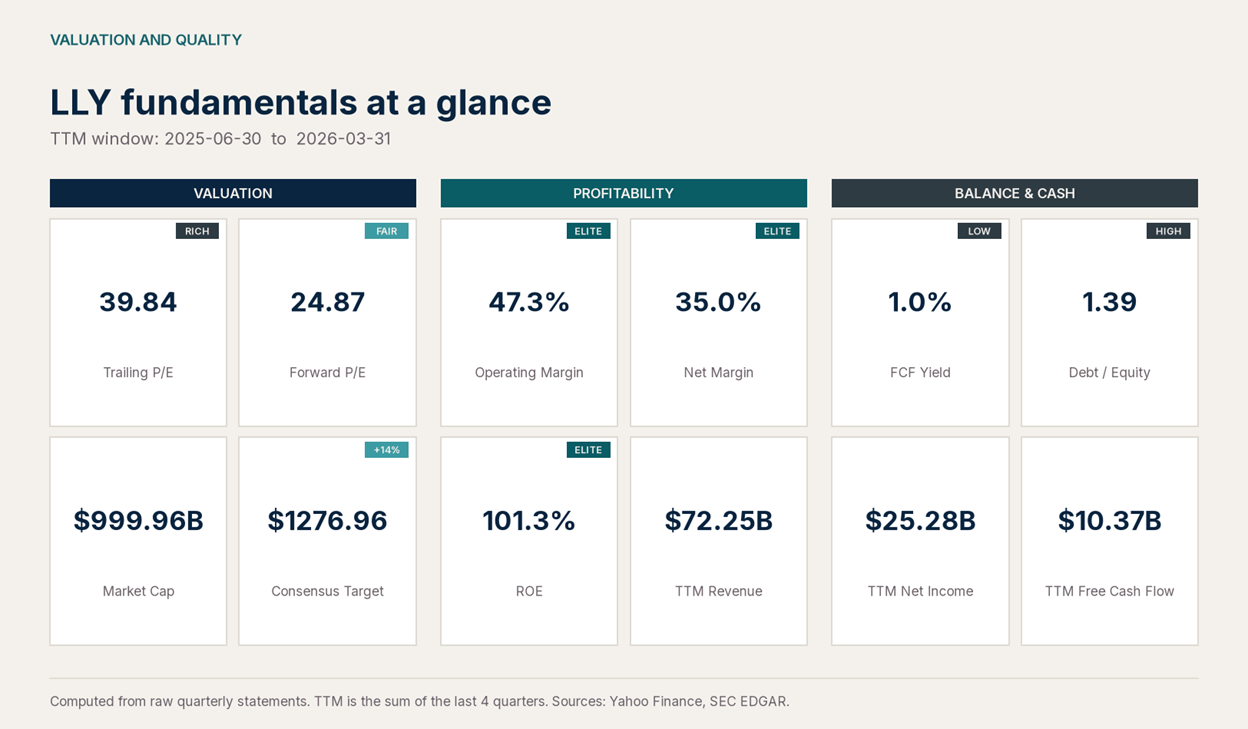
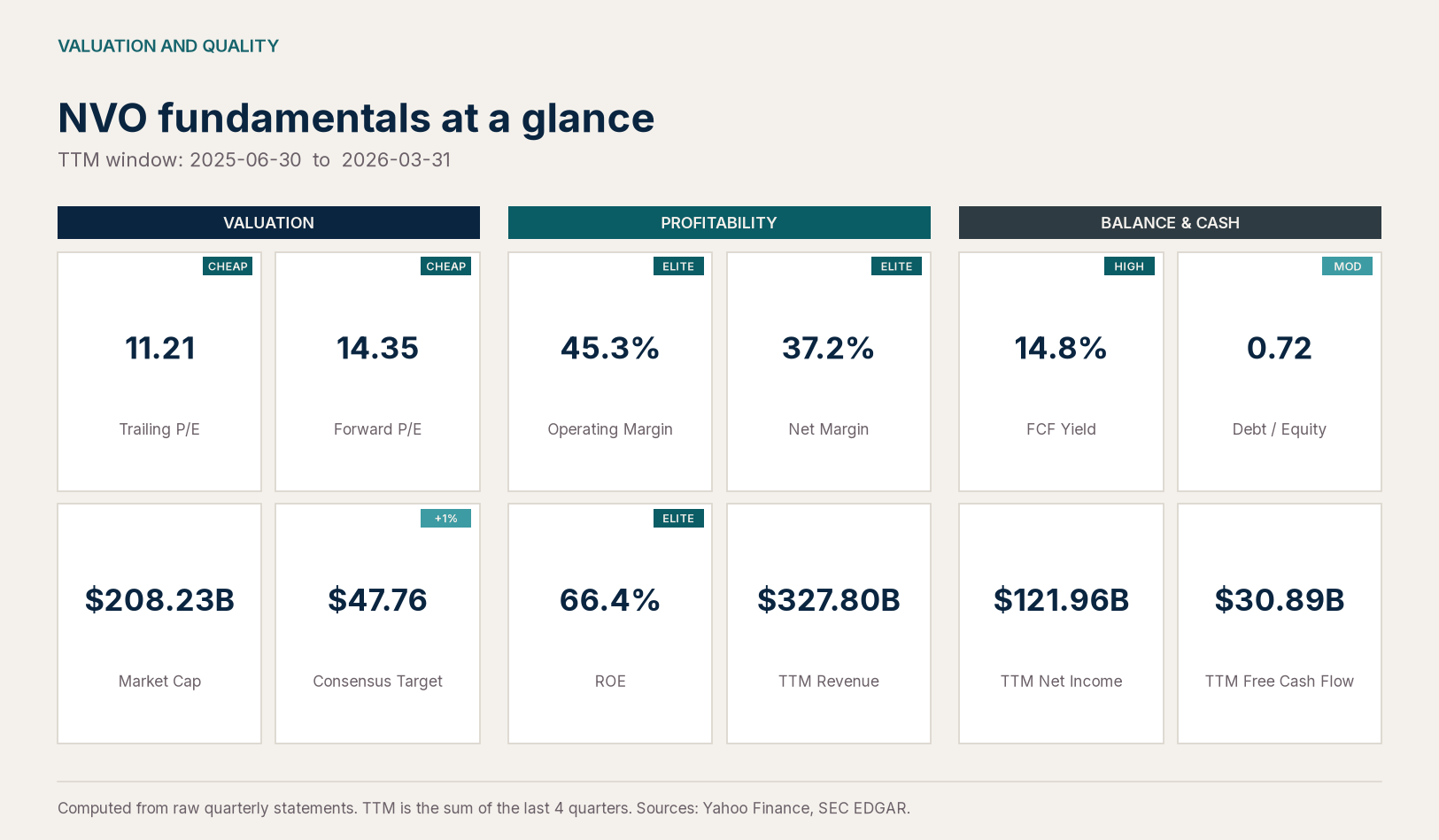
On valuation, Lilly trades at 39.6x trailing earnings with a 1.04% free-cash-flow yield. Novo trades at 11.1x with a 2.28% yield (Novo reports in kroner and trades in dollars. Converted properly at 6.49 kroner per USD, the real multiple is 11.1x).
The analysts have already picked a side. Lilly carries 22 buy or strong-buy ratings against 4 holds and 2 sells, mean target $1,277, about 14% above spot. Novo carries zero strong buys, 4 buys and 10 holds, mean target $47.76, which is 1.4% above spot.
Fundamental conclusion: nearly identical margins, completely different futures priced in. Lilly is a compounder at a growth multiple with a thin cash yield and real leverage. Novo is a cash machine at a value multiple whose cash is being eaten by capex while adjusted sales decline. The 39.6x against 11.1x gap is the market’s honest read, not an error.
Technicals
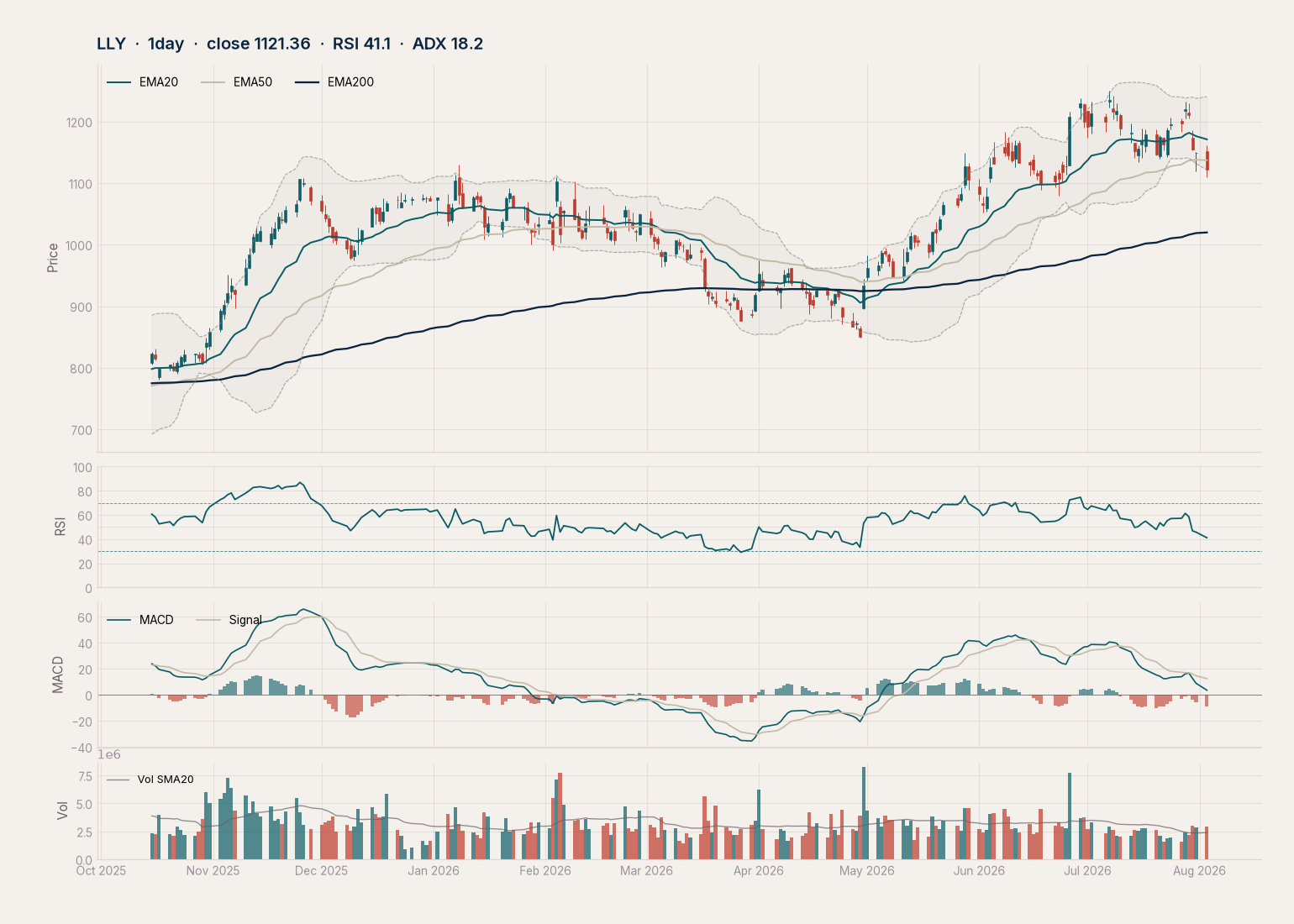
Lilly closed at $1,121.36, sitting exactly on its lower Bollinger band. On the daily chart, It’s below the 20-day at $1,171.09 and the 50-day at $1,137.27, but still above the 100-day at $1,085.53 and the 200-day at $1,019.86. RSI is 41.1. ADX at 18.2 means no strong trend in force, just drift. Williams %R at -90.1 says the last 14 sessions have been one-way traffic down.
The weekly says don’t panic. Price holds above the EMA20 at $1,094.05, the 50 at $1,003.34 and the 200 at $752.77, with weekly RSI at 59.0 and ADX at 31.0. That’s a strong long-term trend taking a sharp short-term correction.
Novo closed at $47.09, pinned between its own averages. Below the 20-day at $49.00 and the 50-day at $47.35, above the 100-day at $46.19, and below the 200-day at $48.59 which still caps the whole downtrend. RSI is 43.3 and ADX 22.4, a stronger trend reading than Lilly’s, with sellers more firmly in control. It’s also oversold, with Williams %R at -84.8.
Its weekly is the difference. Novo holds above the weekly 20 at $46.19 but sits far below the weekly 50 at $50.39 and the weekly 200 at $65.15. This is a stock trying to build a base, not one in an uptrend.
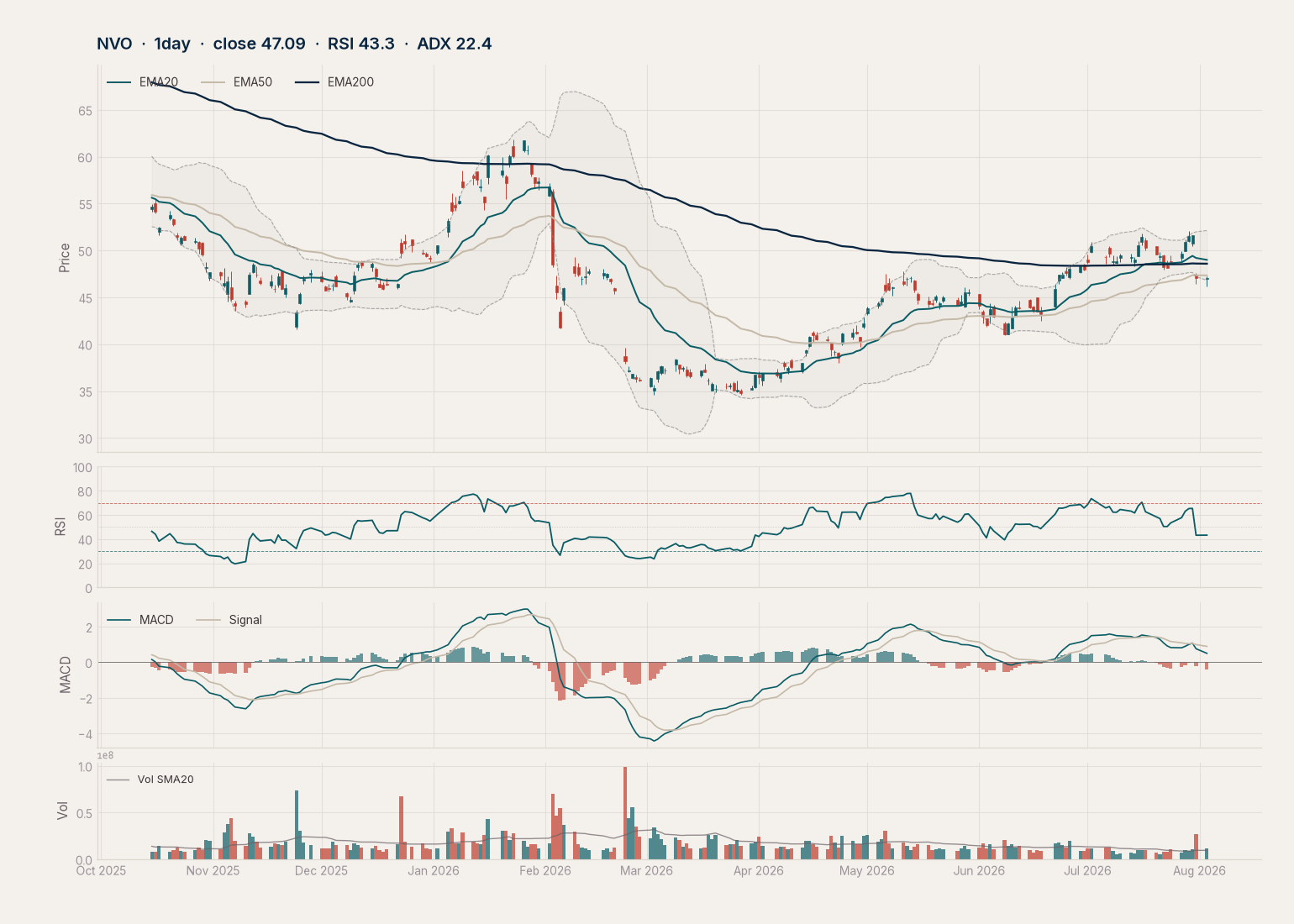
Same sector, same week, same oversold readings. One is correcting inside an uptrend, the other is trying to end a downtrend.
