


Over the past few weeks we wrote about Netflix’s evolving investment thesis.
Then, we saw that the market rewarded capital discipline when Netflix stepped away from the Warner Bros. Discovery bidding war.
Last week, we explored whether the company might be entering a new bull cycle driven by operating leverage and pricing power.
Now we may be seeing the next step in that evolution.
NFLX 0.00%↑ appears to have made a deliberate strategic pivot: instead of pursuing a massive legacy media acquisition, it is investing in AI-driven filmmaking infrastructure.
Netflix acquired InterPositive, an AI film technology company founded by Ben Affleck, reshaping how Netflix thinks about content production, cost structure, and long-term competitive advantage.
The contrast between the two paths is striking.
One was a potential $80B+ acquisition of a traditional studio conglomerate that would have accumulated over $40B in debt on books.
The other is a relatively small technology acquisition (reportedly $600 Million) that could fundamentally alter the economics of filmmaking.
From a capital allocation perspective, the implications are significant.
The Deal Netflix Walked Away From
When reports emerged that Netflix had considered participating in a potential Warner Bros. Discovery acquisition scenario, the strategic logic was obvious.
Warner Bros. Discovery owns one of the deepest content libraries in the world, including:
HBO
Warner Bros. Pictures
DC Studios
Discovery and other networks
A massive catalog of film and television IP
But the economics were far less attractive.
Warner Bros. Discovery carries substantial debt and operates within the legacy media ecosystem that streaming companies have spent the past decade disrupting.
Even if Netflix could extract synergies, the deal would likely have required tens of billions in capital and years of integration complexity.
The financial trade-off becomes clearer when looking at WBD 0.00%↑’s cash generation.
Recent filings show that WBD generates several billion dollars of annual operating cash flow, but that cash must service:
Significant debt
Legacy cable network declines
Expensive film and TV production cycles
In other words, acquiring WBD would not simply be buying a library.
Netflix would also be inheriting a large legacy cost structure and structural industry headwinds.
For a company trading around 35x earnings, investors expect Netflix to invest in future growth, not consolidate declining media models.
That is precisely why the market reacted positively when Netflix walked away.
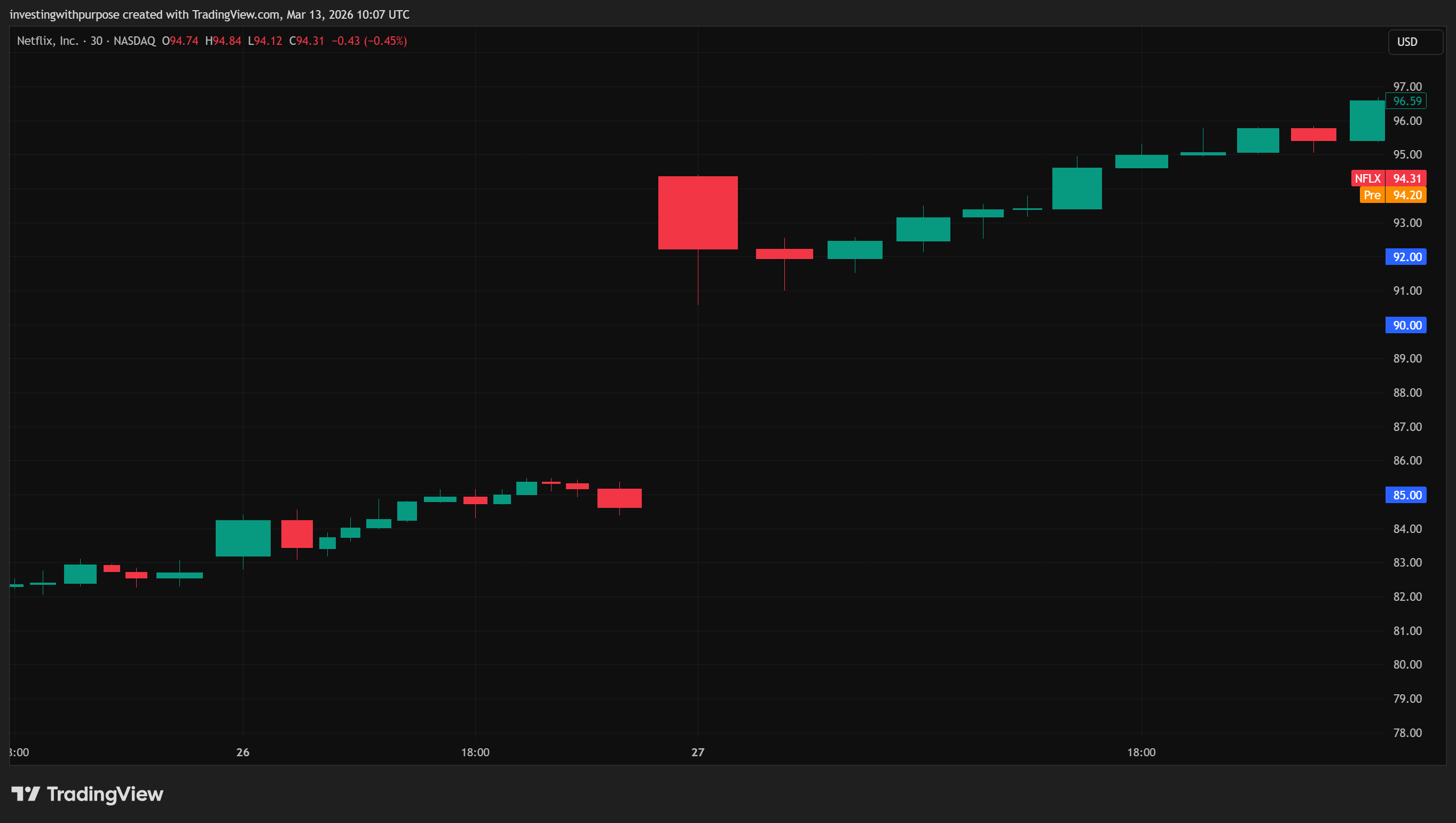
NFLX 0.00%↑ chart between February 26 and February 27 2026, showing the stock jump after announcing they will drop the WBD 0.00%↑ offer
A Different Kind of Acquisition
Instead of deploying massive capital toward legacy assets, Netflix is investing in AI-driven production technology.
InterPositive was built in stealth. Prior to the Netflix acquisition announcement last week, the company had no public profile.
What it did have was a foundational technology thesis and a founder with both the credibility and the creative standing to build something that could actually work inside Hollywood.
Ben Affleck began building InterPositive in 2022. He observed, as many filmmakers did, that the early wave of generative AI tools in production were designed around text-to-video prompts and large general-purpose models, architectures that fundamentally misunderstood what filmmakers actually need. The nuances of lens distortion, the consistency of lighting across scenes, the visual logic of editorial continuity: none of these were being built into the tools being rushed to market.
InterPositive’s approach was different. They filmed a proprietary dataset on a controlled soundstage rather than train on scraped internet data, generating training material that reflected the real vocabulary of production. The resulting models were purpose-built for the actual challenges cinematographers and directors face: missing shots, background replacements, inconsistent lighting.
Critically, the technology was designed with restraints and guardrails that protect creative intent and keep artistic decisions in the hands of the filmmaker rather than the algorithm. This is not a tool that generates content autonomously. It is a tool that expands what a filmmaker can do with the creative choices they have already made.
The team is 16 people. Affleck joins Netflix as Senior Advisor. The entire acquisition is a full integration, which means InterPositive’s technology is now exclusively Netflix’s.
That exclusivity is a strategic asset.
Disney, for comparison, recently signed a licensing arrangement with OpenAI, giving it access to select character IP in exchange for an investment. That is a vendor relationship. Netflix has built proprietary infrastructure.
For Netflix, that creates an entirely new strategic position.
From the invention of the moving image to the transition to digital, from motion capture to virtual production, technology has evolved alongside the artists who use it.
The Financial Logic: Small Price, Asymmetric Upside
Reports say NFLX 0.00%↑ is paying $600 Million for InterPositive. Contrast that with what WBD 0.00%↑ would have cost. The bridge financing alone was $42.2B. The debt inherited would have pushed net leverage to levels that would have constrained every other capital allocation decision Netflix might want to make over the next five years.
The WBD free cash flow Netflix would have acquired (roughly $3-4B annually, declining) would have been partially offset by debt service costs that could easily exceed $2B per year on a $40B+ debt load at current rates. The net incremental cash generation would have been modest, while the integration risk and management distraction would have been enormous.
InterPositive, by contrast, contributes something that cannot be valued on a DCF model today: a structural advantage in the most disruptive technology trend in the history of film production. If AI filmmaking tools mature at the pace that AI tools in other creative industries have matured, Netflix will have moved from content licensor to technology owner, a position that could compress production costs, expand creative possibilities, and widen the moat against every competitor that has to buy these capabilities from a vendor.
Let’s see if anything about this is announced when they report Q1 2026 earnings on April 16 at 4:01 PM ET.
The Bigger Picture: Netflix Is Redefining What a Content Platform Looks Like
We have argued across our prior analyses that the market is repricing Netflix from a subscriber growth story to an earnings quality and free cash flow durability story. That repricing is real, and the InterPositive acquisition deepens it.
Consider what Netflix is now building:
A global streaming platform with 325M+ paid subscribers and structural pricing power
An advertising tier that more than doubled revenue year-over-year in 2025 and is now large enough to matter to consolidated margins
An owned content studio operation, increasingly disciplined in its content spend relative to amortization
A first-look deal with Artists Equity (the production company led by Affleck and Matt Damon) reinforcing the creative partnership that InterPositive sits within
A games ecosystem built on proprietary identity infrastructure. Through the December 2025 acquisition of Ready Player Me, Netflix gained the cross-game avatar layer that makes its growing games library feel like a coherent platform rather than a disconnected app shelf. A subscriber who games on Netflix churns less
Proprietary AI filmmaking technology, exclusively owned, purpose-built for production, designed with creative guardrails that align with the talent relationships Netflix has spent years cultivating
That last point deserves emphasis.
Netflix’s relationship with the creative community is a competitive asset that is difficult to quantify but easy to lose. The 2023 strikes were, in part, a crisis of trust between talent and studios over AI. Netflix’s acquisition of InterPositive, technology built by a filmmaker, designed to protect creative intent, announced alongside explicit commitments from both the Chief Content Officer and Chief Product Officer that these tools will expand rather than replace human creativity, is a calculated positioning decision.
It signals to the talent community: we will use AI the way you would want it used.
That signal, credible because it is attached to Ben Affleck and built into the architecture of the technology itself, is worth more than any licensing deal Netflix could have signed with a general-purpose AI provider.
The Thesis Holds, and Gets Stronger
In January, we wrote that 2026 would be Netflix’s most important year since streaming won.

The stakes were high because the market was recalibrating: could Netflix be both a premium compounder and a disciplined capital allocator? The WBD bidding process was a test. Netflix passed it.
In early March, we made the case for a new bull cycle, built on the foundation of a completed technical reset, improving fundamentals, and a market that was rewarding earnings quality over growth-at-any-cost.

The InterPositive acquisition adds a new dimension to that case: it is evidence that management is thinking about the next decade, not just the next quarter.
The numbers still matter. Netflix guided $50.7B–$51.7B in revenue for 2026, with operating margins expanding to 31.5% and free cash flow approaching $11B. These are not speculative projections, but the output of a business that has already demonstrated it can execute. The advertising business is real and scaling. The content engine is disciplined. The balance sheet, freed from a potentially crushing acquisition, remains investment-grade and flexible.
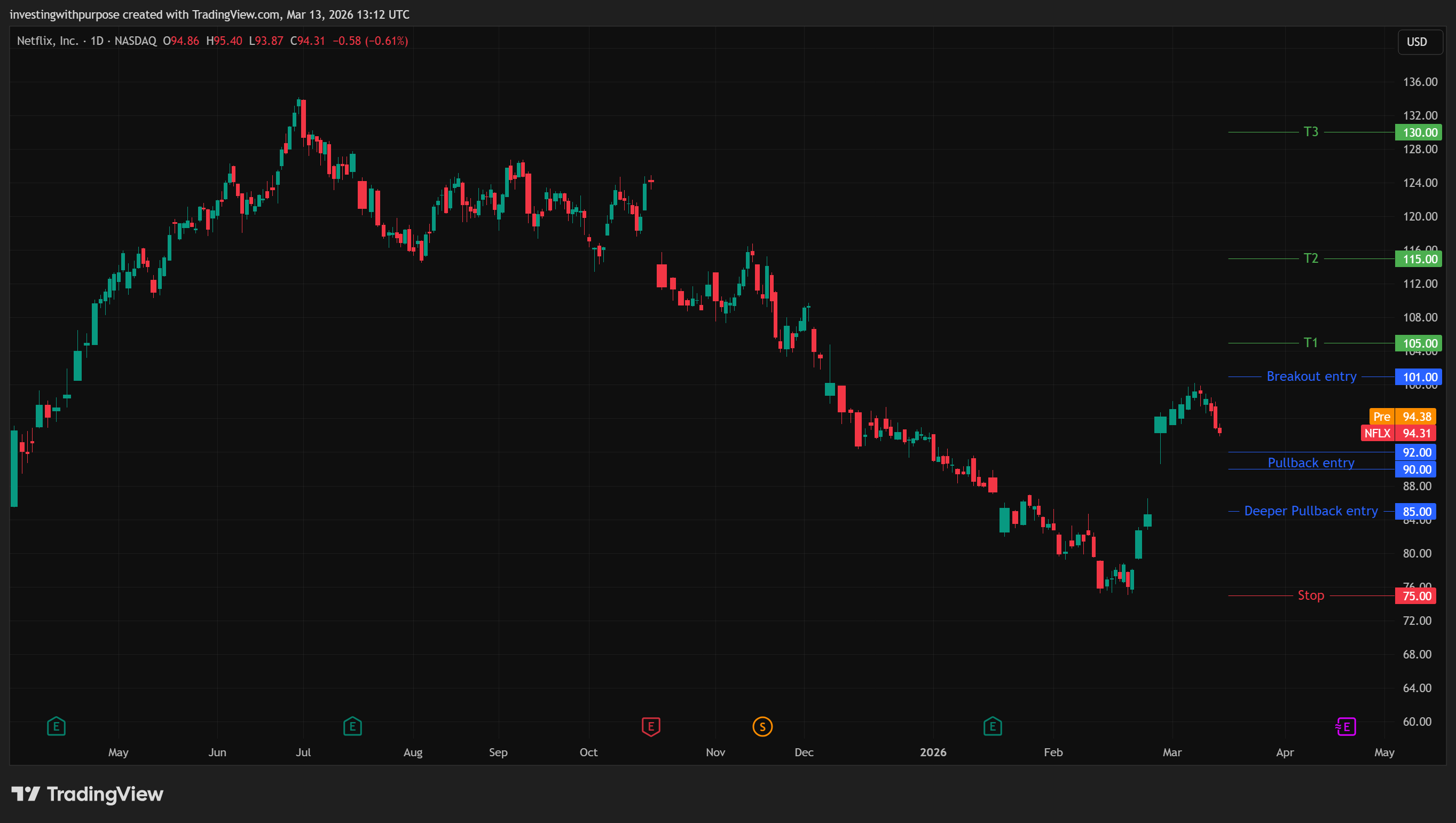
IWP’s latest NFLX 0.00%↑ trade plan
But the InterPositive acquisition adds something that the financial model cannot fully capture yet: optionality. The option to own the infrastructure of AI-driven film production. The option to deepen the creative partnership with Hollywood’s most respected talent through a technology that was built with them in mind. The option to be, in five years, not just the world’s largest streaming platform but the company that defined how stories get made in the AI era.
For medium to long-term investors, this is the Netflix story entering its next chapter. The reset was real. The recovery is underway. The strategic pivot away from empire-building and toward technology leadership is now confirmed.
Capital discipline was always the thesis. Now it comes with a vision for where the industry is going. That combination is rare, and it is exactly what a premium multiple requires.
This publication is for informational and educational purposes only and reflects personal opinions at the time of writing. It is not investment advice, a recommendation to buy or sell any security, or a solicitation to engage in any investment strategy. All investments involve risk, including the possible loss of principal. Past performance does not guarantee future results. Market conditions, company fundamentals, and technical structures can change quickly and without notice. Any price levels, scenarios, or trade frameworks discussed are illustrative examples of how one might think about risk and structure. They are not tailored to any individual’s financial situation, objectives, or risk tolerance.